Unknown's avatar

About kwchas

I am the historian and statistican for Chester Football Club and have written a number of books on the subject. The most recent of these is 125 Years On The Borderline - The Complete History of Chester City Football Club 1885-2010

Jack Lipsham and Kevin Roberts

On the face of it there is nothing to connect winger Jack Lipsham, who played for Chester at the start of the last century, and current defender and midfielder Kevin Roberts. However the two players have the distinction of having the longest career span representing the club. In Kevin’s case this has spanned both Chester City and Chester FC, and is still ongoing, but both players have their first and last games for the club separated by 18 years. 

Jack played his first game in the opening game of the 1903/04 season, a Combination fixture against Witton Albion, with his last game coming after the First World War in March 1921. Kevin made his debut in the first away fixture of the 2007/08 season at Rochdale and is, of course, still a regular member of the team in 2024/25.

An outside left John Lipsham, better known as Jack or Jacky, was one of four brothers to play for the club. The most successful of these was Bert Lipsham who represented Chester in 1896 and 1897 and went on to play 235 times for Sheffield United winning an FA Cup winners medal in 1902 as well as an international cap for England. William, who was five years older than Bert, played twice for the club during the 1897/98 season while younger brother Tommy made his debut in 1901 and played at outside right until the end of 1904. The latter’s career overlapped that of his older brother Jack at Whipcord Lane while during the 1902/03 campaign both Tommy and Jack also played for Sheffield United Reserves where their brother Bert was in the first team. 

Jack was born in Chester in October 1881 and started his football career with Chester St John’s in the Chester and District League. At the end of the 1901/02 campaign St John’s were taken over by Chester and run as their reserve team with Jack a regular alongside brother Tommy. In September 1903 he made his first team debut at Whipcord Lane scoring one of the goals in a 5-0 win over Witton Albion. Over the next three seasons he only missed two Combination fixtures and was leading scorer in 1905/06. Although only 5ft 6in tall he was a well-built player and his speed down the wing and accurate crosses attracted the attention of First Division Liverpool who signed him in summer 1906. However, Jack only made three appearances for the Anfield club before returning to Chester the following year. 

By this time the club were playing at Sealand Road and Jack rarely missed a game as the club won the Welsh Cup for the first time in 1908 and the Combination League in 1909. By 1913 he had amassed more than 250 league games, a great achievement given that the number of fixtures per season ranged from only 24 to a maximum 38. In March 1913 the league fixture against Hyde was designated as a benefit for Jack and his colleague Billy Matthews in recognition of their great service and the princely sum of £82-10s was raised. Surprisingly Jack signed for Wrexham during summer 1913 but nevertheless remained a popular figure and returned to Sealand Road after the war when Chester became founder members of the Cheshire County League. He played his last game for the club in March 1921, against Stalybridge Celtic Reserves, at the age of 39 having made more than 300 first team appearances. Jack was also an enthusiastic cricketer and represented Chester St John’s while at the end of his football career he was a cashier clerk at the Army Pay Office and later became general manager of the Chester Steam Laundry in Boughton. He died in 1959. 

Jack Lipsham – (Front Row 2nd from left) – Chester St John’s Cricket Club 1907

Of more recent vintage Kevin Roberts graduated from the Chester youth team and was given his debut by Bobby Williamson in central midfield, having just turned 18, in a 2-1 victory at Rochdale in August 2007. Two weeks later he went on to score his first goal in a 1-1 draw at Rotherham. Over the next three seasons he became an established first team regular making 81 Football League appearances in total. Following relegation he featured in all 28 Blue Square Premier league games in the aborted 2009/10 season and was a member of the team that lost 2-1 to Ebbsfleet United in the final game for Chester City.

Following the old club’s demise Kevin played for Cambridge United, Brackley Town (on loan), FC Halifax and Wrexham before returning to the Deva Stadium in 2019. Since then he has been a crucial member of the Blues squad and is fast closing in on his 200th first team appearance. On current form it would be hard to bet against him extending his record into 2026 although it is worth noting that Connell Rawlinson played his first game for the club in the dying days of Chester City, against Oxford United in August 2009, and currently has a span of 16 years. 


Copyright ©  Chas Sumner http://www.chesterfootballhistory.com All Rights Reserved

“Metcalf vs Puskás: The Forgotten Game” – Uncovering a Chester FC Legend’s Tale

Mike Metcalf’s grandson Daniel is working on an interesting documentary about a charity match played at South Liverpool’s ground in 1967. If you think you can help then please get in contact with him and check out his website http://www.metcalfvspuskas.com.

*****************************************************************************************************************

I’m Daniel Metcalf, grandson of Chester FC legend Mike Metcalf, and I’m excited to share with you a project that’s very close to my heart. First, I’d like to thank Chas Sumner for allowing me to share this announcement on his blog and for his invaluable assistance in the pre-production of my upcoming documentary.

The Documentary

I’m directing a documentary called “Metcalf vs Puskás: The Forgotten Game,” which explores a remarkable yet little-known charity football match from 1967. This film will chronicle how some of Britain’s biggest footballing stars, including my grandfather Mike Metcalf, took on a Ferenc Puskás International XI for charity.

Our production aims to uncover a forgotten piece of football history that’s particularly significant to Chester FC fans. We’ll not only reconstruct the charity match but also delve into my grandfather’s broader career – from his beginnings as an adopted child to his successful stints at Wrexham and, of course, his prolific time at Chester FC.

I’m grateful that the club has granted us access to their archival material and permission to film at the stadium. This support will be crucial in faithfully representing Chester FC’s heritage in our documentary.

Call for Contributions

We’re actively seeking contributions from the Chester FC community. If you or someone you know fits any of these categories, we’d love to hear from you:

  1. Family members/relatives of players involved in the Puskás charity match
  2. Spectators from the 1967 game
  3. Anyone with materials/memorabilia relating to the game
  4. Former teammates of Mike Metcalf with stories to share
  5. Football historians knowledgeable about Chester FC in the 1960s

How to Get Involved

If you have information, stories, or memorabilia to share, or if you’re interested in supporting this project, please don’t hesitate to reach out:

  • Email: contact@metcalfvspuskas.com
  • Mobile: 07930 594279
  • Website: www.metcalfvspuskas.com
  • Facebook: www.facebook.com/MetcalfVsPuskas

Player Profile – Wally Hughes

A friend was recently telling me about an article he had written for the Prescot Cables programme a few years ago which mentioned a player called Wally Hughes who briefly featured in Chester colours. While his stay at Sealand Road was restricted to three games for the Cheshire County League team he had a fascinating career managing both the New Zealand and Fiji national teams. The following article is reproduced with Roy McDonald’s kind permission and can also be seen on his Tales From Hope Street blog page. It is well worth checking out his other articles which can be found at:

https://roymcdonald.wixsite.com/blog

I researched his ‘career’ at Chester and Wally was signed by Stan Pearson on a one month trial in August 1959 after playing in the Possibles v Probables public trial match. The 25 year old outside right made his first start in the opening Cheshire County League of that season at home to Ellesmere Port Town. It proved to be a memorable debut as, after an uneventful first half, he scored the only goal of the game against the reigning Cheshire County League champions. 

Also making his debut for the reserves that day was 17 year old Ron Davies who, of course went on to have a long career with Luton Town, Norwich City, Southampton and Manchester United amongst others and was capped 29 times by Wales. 

Wally then played in the 1-1 draw at Bangor City followed by a 4-0 defeat at Northwich Victoria where he switched to the left wing to make way for promising 17 year old youngster Jimmy Cooper. Although he was described as ‘lively’ against Vics it proved to be his last game and he was released in September at the end of his trial.

The following is a reproduction of Roy McDonald’s ‘Cables to Kiwis’ article:

Walter Cyril Joseph Hughes was born in Dingle, Liverpool in 1934. Wally was an extrovert character who began his career on the groundstaff at Liverpool F.C. and, at 18, earned a playing contract. He was signed on professional forms on returning from the Forces shortly after the start of the 1954/55 season, but did not make the progress anticipated. He failed to make an appearance for the first team, and in April 1955 he was given a free transfer.

He became the archetypal journeyman footballer when he moved on to Stockport County where he, again, failed to make the first team squad and drifted on to Winsford United in the Cheshire League. Hughes returned to league football when he joined Sheffield United in early 1956, to become new manager Joe Mercer’s first signing. Injuries meant that within two weeks Wally was promoted to the first team, where he impressed on his debut, creating two goals for the Blades. However, he made just two first team appearances, before he was sent on loan to Midland League side, Wisbech Town in October 1956

In April 1957 he moved to Bradford Park Avenue (20 appearances), and on to Southport in February 1958 (11 appearances), making it seven clubs in three years. After Southport, Hughes continued his nomadic roam around football, returning to Winsford United, then Bangor City and Rhyl, before earning a month’s trial with Crystal Palace in early 1959. In August 1959 he landed at Chester. By the start of the 1960/61 season he was at Earlestown in the Lancashire Combination, and he began the 1961/62 with Prescot Cables – by my reckoning, his fourteenth club in eight seasons.

During these later years, Wally had taken his F.A. coaching badges and worked in coaching clinics for the F.A. and the Liverpool Coaching Association and also worked part-time for Cheshire Education Authority. In December 1961 Harry Topping was sacked as Manager of Cables and Wally was appointed player-coach. It is very likely that Prescot Cables was Wally’s first role in team management.

However, things did not go well for Hughes at Hope Street and within 3 months he, too, was replaced this time, by ex-Cable, Dick Platt.

In February 1962, the Liverpool Echo reported that, “Prescot Cables have released two of their professionals, inside forward and player-coach Wally Hughes and goalkeeper Jack Critchley. Hughes was at one time on Sheffield United’s books and has played in Italy.” [I have, so far, been unable to verify his time in Italy]

Wally went on to play for Cambridgeshire side, St Neots Town in the Metropolitan League before coming back to Merseyside, again, to join New Brighton for the 1963/64 season. Unsurprisingly, his stay with the Rakers didn’t last long and in March 1964 it was reported that his contract had been cancelled.

In 1973, Wally Hughes emigrated to New Zealand, where he took up the role of head coach of Dunedin City in the Southern League. At Dunedin he worked alongside another Prescot old-boy, Alan A’Court and took them to promotion in his first season.

After two seasons he became Director of Coaching for the New Zealand Northern Region and took charge of the Auckland representative side that played visiting teams like Manchester United and Tottenham Hotspur. In late 1976 he was appointed coach of the Kiwi’s national football team, for the 1978 FIFA World Cup qualifying campaign. On his appointment Hughes set his sights high, saying, “We are going to have a different attitude. We have been negative in the past but this time we will be positive and aiming high. My ultimate aim is to reach the last 16 of the competition and that means we have to win the Oceania group qualifying games first”.

Hughes first took charge of the New Zealand side in February 1977, winning six, losing five of his 12 games in charge, with one draw.

However, New Zealand failed to qualify for the 1978 World Cup and after Hughes stepped down from the National team he coached in the New Zealand National league, before taking an appointment with the Al Ahli club in Dubai for 2 years, where he worked closely with the former Leeds United and England manager Don Revie, who was then in charge of the UAE National side. Wally said, “Of course, there were a few problems. There was the language problem for one thing. About 90 per cent of the players don’t speak a word of English. You lose something in imparting your message through an interpreter”. Revie gave Wally a glowing reference, writing, “I have watched him work and worked with him in coaching sessions, and I have no doubt in my mind that he is a very good coach indeed”.

After his stint in UAE he returned briefly to Merseyside, and was offered the chance to coach a Norwegian side. He said, “I am looking for a challenge. That’s what football is all about”. That challenge came when he took charge of the Fiji national side in 1981 for their first entry into the World Cup qualifying campaigns. After opening up with a four goal defeat against New Zealand, they drew 0 – 0 with Indonesia, before defeating Chinese Taipei 2–1. However, that was as good as it got, with crushing away defeats against Australia (10 – 0) and New Zealand (13 – 0) in the space of 48 hours. Hughes resigned after the Australian game, claiming that there was interference from Fiji team management and that he did not have a free hand in team selection, talks and tactics.

“I wouldn’t wish on any coach what I have been through,” he said. He claimed that some of his officials were working against him and that the match against the Socceroos was thrown away with one defender being responsible for letting in at least seven goals. He added that this defender went on a drinking spree with a team official after the drubbing at the hand of the Aussies. New Zealand eventually went on to reach the World Cup finals in 1982 in Spain. Hughes returned to New Zealand to coach at East Coast Bays AFC, Auckland University and Manurewa AFC.

As a coach, Wally Hughes was well regarded by contemporaries for his skills and knowledge of the game and for the standards he set, and is given much credit within New Zealand for laying the groundwork for the national side’s eventual qualification for the World Cup finals.

Wally Hughes died in Auckland, New Zealand in January 2011.

Gary Simpson (1959-2023)

Former centre forward Gary Simpson has passed away at the age of 64. Gary joined Chester in summer 1981 and made 63 Football League appearances over the following two seasons scoring 18 goals. 

Born in Chesterfield, Gary joined his local club as a schoolboy and after signing professional in 1977 made his Football League debut for the Spireites, at Plymouth Argyle, in November of the same year. Over the next four seasons he made 43 appearances for the Saltergate club without truly establishing himself as a first team regular. In 1981 Alan Oakes brought Gary to Sealand Road for £6,000 in an attempt to invigorate a team that had struggled to find goals since the departure of Ian Edwards and Ian Rush.

Gary was unfortunate to sign for the club as financial problems began to bite and with a small squad Chester were out of their depth in Division 3 finishing bottom of the table winning just six games and managing only 36 goals. Gary himself finished leading scorer with 12 of these goals including two at his former club Chesterfield in an unexpected 5-3 win. 

The signing of John Thomas, following relegation to Division 4, saw some of the goalscoring pressure taken off Gary and he added another six goals as the club stabilised in mid-table. Nevertheless the financial situation was worsening and at the end of the 1982/83 season Gary was one of eight players released by the club as manager John Sainty was tasked with halving the wage bill. 

After leaving Sealand Road Gary joined a host of former Chester players at Oswestry Town and also played for Bangor City and Connah’s Quay Nomads. 

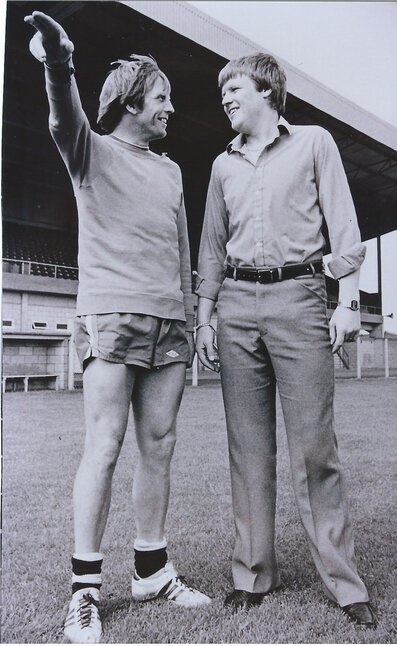
Alan Oakes welcomes Gary to Sealand Road

The Ground That Never Was

At the end of the 19th century the large scale housebuilding in Hoole was beginning to encroach on Chester’s ground in Faulkner Street and it became clear that a new home would be needed if the club was to continue. One of the options was the nearby Lead Works Field sandwiched between the Shropshire Union canal and the railway line. In the end the plan, for an all purpose athletics field, never got off the ground but had the project gone through it could have altered the whole history of the club.. 

The completion of the 1896/97 season saw Chester Football Club in turmoil, not for the first or last time. The club seemed to be drifting along aimlessly with no committee meetings taking place and it was essentially being run by the secretary and players. No accounts had been produced for several weeks and the debts were mounting while the players, who had been unpaid, were refusing to continue into the new season if the current committee was still in place. On top of all this the Faulkner Street ground itself was becoming a major headache as new housing edged ever closer. Ironically, all this upheaval came at a time when the club was achieving some success on the field of play having just won the Cheshire Senior Cup for a second time. Such were the internal problems that a couple of the players refused to appear in the team photograph taken with the cup at the end of the campaign.

The 1897 Cheshire Cup winners minus a couple of boycotters

The formation of a new committee during the summer saw some sense of normality return to the club although they controversially refused to take on the debt overseen by the previous regime. One of the reasons for adopting this stance must have been the costs involved in preparing for the forthcoming 1897/98 campaign. The landlord of the Faulkner Street ground wanted to increase the rent but the club also faced the prospect of moving the hoardings closer to the pitch at a cost of £50, a move which would only have been a temporary measure. The alternative was to find a new ground with two or three options available. A field by the Lead Works looked the most viable choice but in the end the club decided to remain where they were for another season as it was felt that the cost implications of erecting new hoardings, moving and levelling the pitch were even more prohibitive than staying where they were. 

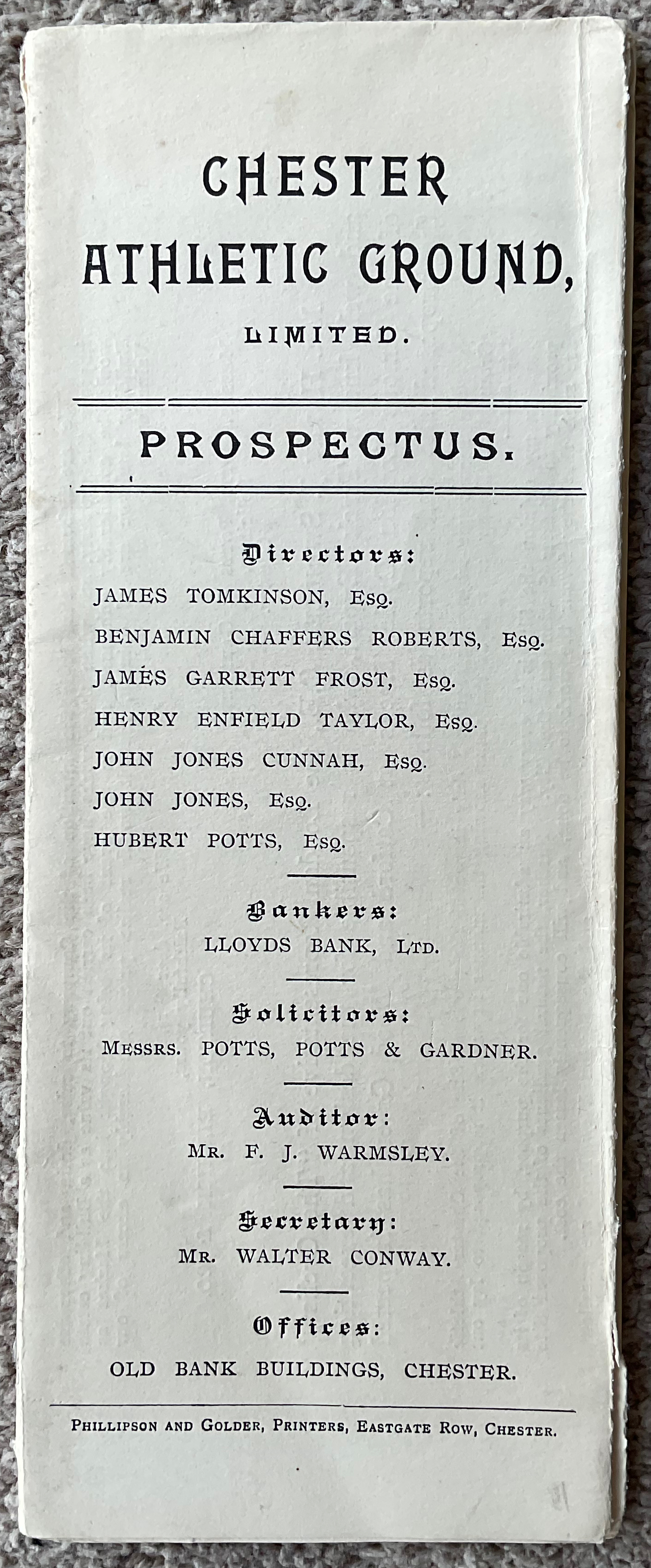
Nevertheless the Lead Works Field looked an attractive option for sport and in April 1898 a share prospectus was issued by a new company called the Chester Athletic Ground Limited. They proposed issuing 700 shares at £10 each in order to purchase the land and fund a high class athletic ground adapted and equipped for a range of sports and pastimes. The company estimated that their ambitious venture would cost around £8,800 with the balance met through mortgaging the property.

Although the football club was not directly involved they had come to an agreement with the Athletic Company to play their matches at the ground and were a key component if the scheme was to succeed. 

James Tomkinson

The men behind the company were all prominent figures in the area. The chairman, James Tomkinson, was a bank director who owned Willington Hall near Tarporley and later went on to become Liberal MP for Crewe until his death in 1910. Others involved included Benjamin Chaffers Roberts, a retired tea merchant who had built and lived at Oakfield house, which now stands at the heart of Chester Zoo. Another director was James Frost, a corn miller and JP who lived at Boughton Hall while other directors included solicitor Hubert Potts, Land Agent John Cunnah and Civil Engineer Henry Taylor. 

While football was important to the pioneering project the main focus was on cycling which was going through a boom period with new technology seeing a surge in activity. The introduction of the “safety bicycle” with equal, smaller sized wheels as well as the inflatable tyre both helped fuel this interest. The local papers had regular columns on the sport and the Faulkner Street ground had hosted the first race meeting of Chester Cycling Club which attracted more than 1000 people on a Wednesday evening in July 1897.

The scale and range of the project was certainly ambitious because as well as football and cycling there were also plans to include a running track, inside the banked cycle track. In addition the prospectus also mentioned lawn tennis courts for the summer as well as cricket and croquet alongside horticultural and other shows and entertainments.

The prospectus highlighted the proximity of Chester General Station which was “less than five minutes walk” away with access from City Road down what is now Queen’s Road. From the other direction there would have been entrances by the canal bridge on the junction between Station View Road and Hoole Lane. Part of the proposed site is now covered by the extension to Westminster Road which has by-passed Station View Road and made it into a cul-de-sac. 

The proposed 6 acre site of the Chester Athletic Ground

Within the prospectus it was suggested that the ground would hold 20,000 people and as well as stands, dressing and bath rooms there would also be other recreation and amusement facilities.

Despite the best intentions and high profiles of the people involved the project never got off the ground and the share application only realised around £4,000 of the £7,000 needed. One of the drawbacks is that the price of £10 a share was felt to be well out of the range of the working man and it was felt that there might have been a better take-up if they had been priced at a more reasonable £1. Meanwhile the men behind the Chester Athletic Ground company had come to the conclusion that the ground was not large enough to make it pay and it is difficult to see how they could have accommodated the suggested number of spectators in the limited space after a football pitch, cycle track and athletics track had been installed.

As far as the football club was concerned it seems that it was more a case of jumping at the only opportunity available. The imminent loss of the Faulkner Street enclosure created a sense of urgency and purchasing and converting the Lead Works Field would have been outside Chester’s financial capabilities. Having someone else construct a ground and then renting it from them would have been an ideal solution but the football side of the project seems to have been of secondary importance to the cycle track. It is hard to believe that the ground would have been suitable for watching football with spectators a long way from the action and I’m sure the drawbacks of sharing a ground with multiple sports would have soon become problematical. It certainly wouldn’t have been a long term solution. 

In the event Chester were forced to vacate Faulkner Street in 1898 and decamped a few hundred yards down the road to what was only a temporary home at the Old Showground in the Panton Road and Vicarage Road area of Hoole. That ground only existed for one season when housing again took over and for two seasons the club temporarily disbanded before emerging on the other side of the city on Whipcord Lane in 1901.

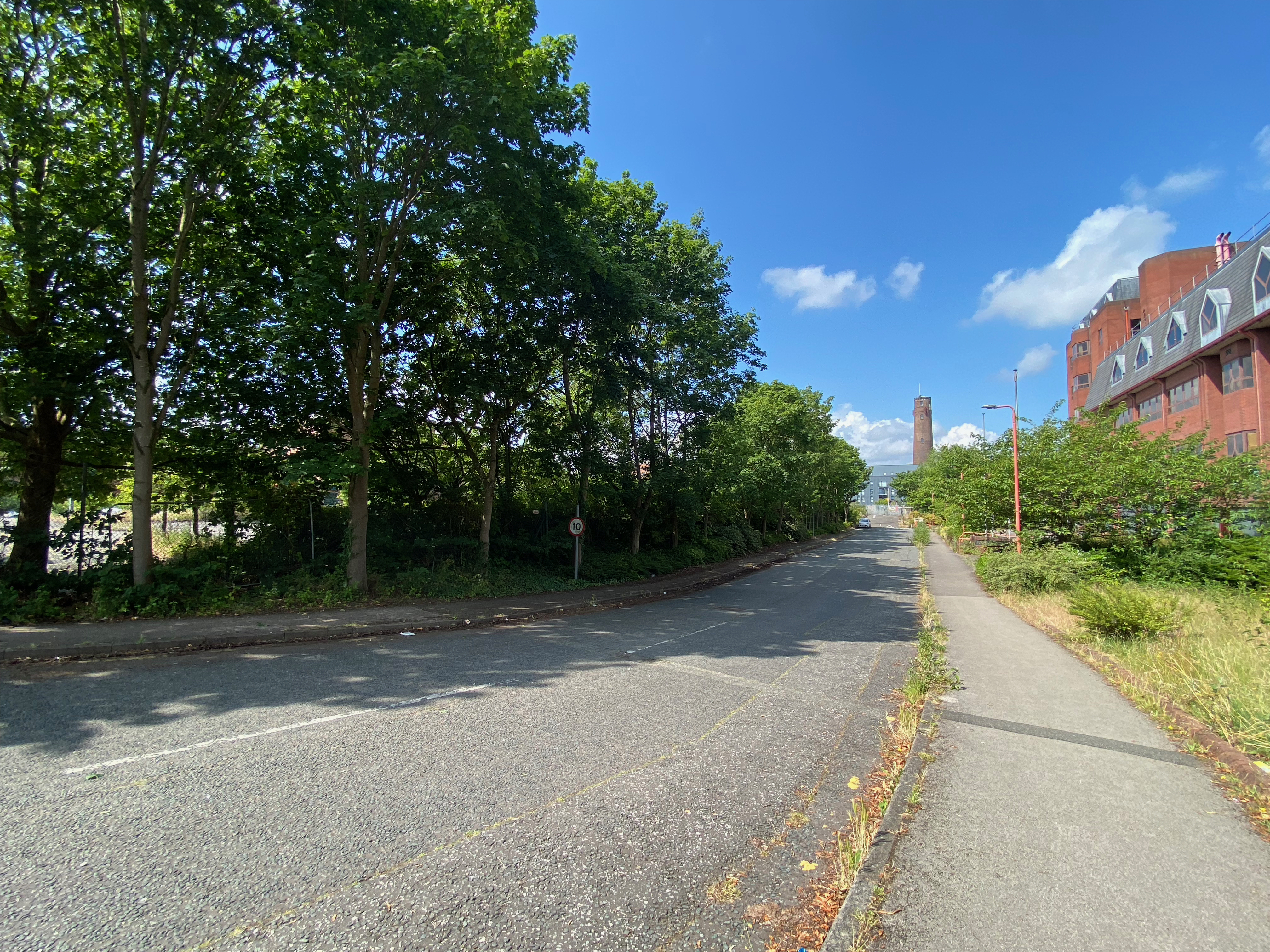
As an afterthought I went down to the area to see if I could get a couple of photographs to accompany the article. The old Lead Works Field is currently covered by two derelict office blocks and an overgrown car park and is for sale although the area available is now 4.34 acres. It did occur to me that if there are any multi-millionaires with money to burn and a huge amount of imagination it would still make a terrific but impractical site for a Stadium, minus a cycle and running track of course.

The old Lead Works Field currently For Sale giving a good view of the area sandwiched by the railway and canal

The junction of Hoole Lane, Station View Road and Westminster Road where one of the entrances to the Athletic Ground would have been located
Looking down Charterhall Drive across the centre of what was the Lead Works Field