Former centre forward Gary Simpson has passed away at the age of 64. Gary joined Chester in summer 1981 and made 63 Football League appearances over the following two seasons scoring 18 goals.
Born in Chesterfield, Gary joined his local club as a schoolboy and after signing professional in 1977 made his Football League debut for the Spireites, at Plymouth Argyle, in November of the same year. Over the next four seasons he made 43 appearances for the Saltergate club without truly establishing himself as a first team regular. In 1981 Alan Oakes brought Gary to Sealand Road for £6,000 in an attempt to invigorate a team that had struggled to find goals since the departure of Ian Edwards and Ian Rush.
Gary was unfortunate to sign for the club as financial problems began to bite and with a small squad Chester were out of their depth in Division 3 finishing bottom of the table winning just six games and managing only 36 goals. Gary himself finished leading scorer with 12 of these goals including two at his former club Chesterfield in an unexpected 5-3 win.
The signing of John Thomas, following relegation to Division 4, saw some of the goalscoring pressure taken off Gary and he added another six goals as the club stabilised in mid-table. Nevertheless the financial situation was worsening and at the end of the 1982/83 season Gary was one of eight players released by the club as manager John Sainty was tasked with halving the wage bill.
After leaving Sealand Road Gary joined a host of former Chester players at Oswestry Town and also played for Bangor City and Connah’s Quay Nomads.
At the end of the 19th century the large scale housebuilding in Hoole was beginning to encroach on Chester’s ground in Faulkner Street and it became clear that a new home would be needed if the club was to continue. One of the options was the nearby Lead Works Field sandwiched between the Shropshire Union canal and the railway line. In the end the plan, for an all purpose athletics field, never got off the ground but had the project gone through it could have altered the whole history of the club..
The completion of the 1896/97 season saw Chester Football Club in turmoil, not for the first or last time. The club seemed to be drifting along aimlessly with no committee meetings taking place and it was essentially being run by the secretary and players. No accounts had been produced for several weeks and the debts were mounting while the players, who had been unpaid, were refusing to continue into the new season if the current committee was still in place. On top of all this the Faulkner Street ground itself was becoming a major headache as new housing edged ever closer. Ironically, all this upheaval came at a time when the club was achieving some success on the field of play having just won the Cheshire Senior Cup for a second time. Such were the internal problems that a couple of the players refused to appear in the team photograph taken with the cup at the end of the campaign.
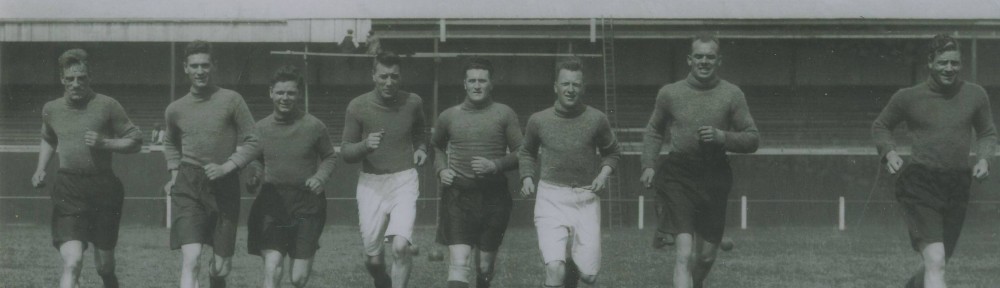
The 1897 Cheshire Cup winners minus a couple of boycotters
The formation of a new committee during the summer saw some sense of normality return to the club although they controversially refused to take on the debt overseen by the previous regime. One of the reasons for adopting this stance must have been the costs involved in preparing for the forthcoming 1897/98 campaign. The landlord of the Faulkner Street ground wanted to increase the rent but the club also faced the prospect of moving the hoardings closer to the pitch at a cost of £50, a move which would only have been a temporary measure. The alternative was to find a new ground with two or three options available. A field by the Lead Works looked the most viable choice but in the end the club decided to remain where they were for another season as it was felt that the cost implications of erecting new hoardings, moving and levelling the pitch were even more prohibitive than staying where they were.
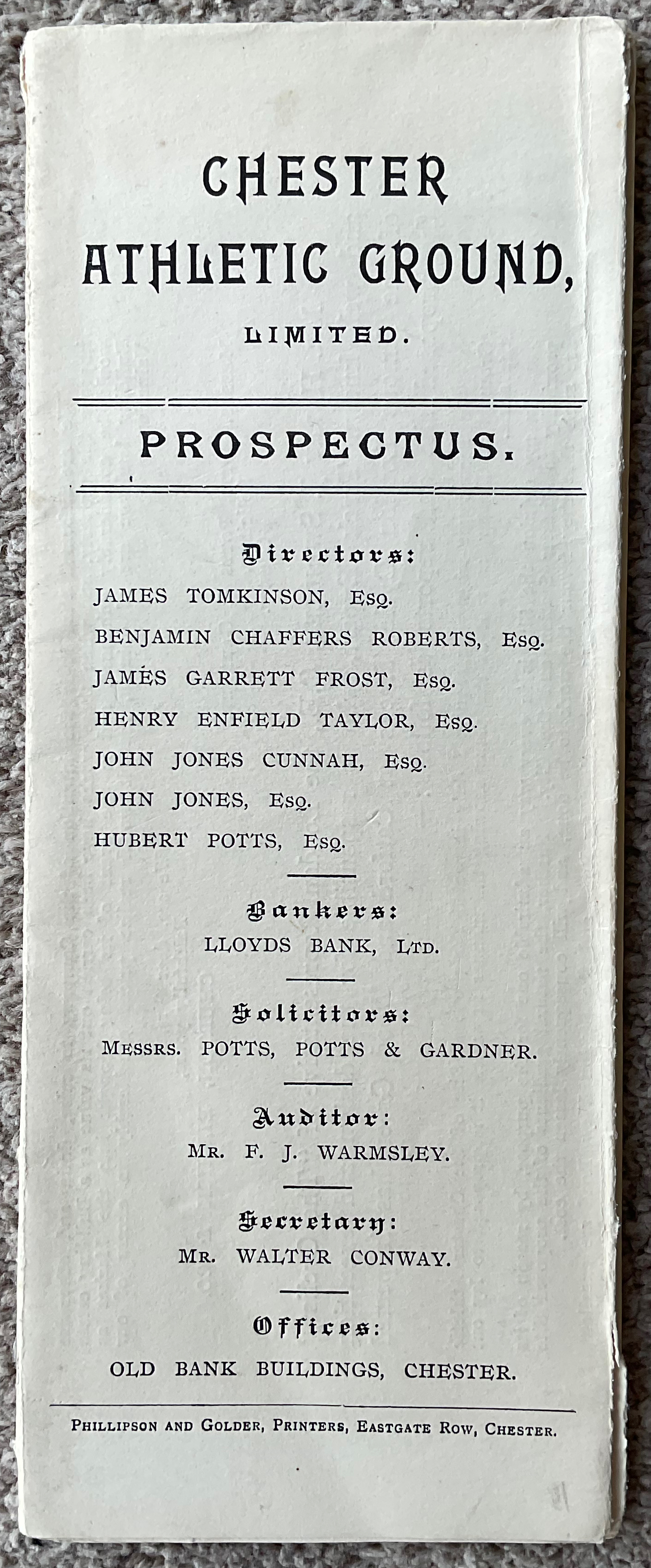
Nevertheless the Lead Works Field looked an attractive option for sport and in April 1898 a share prospectus was issued by a new company called the Chester Athletic Ground Limited. They proposed issuing 700 shares at £10 each in order to purchase the land and fund a high class athletic ground adapted and equipped for a range of sports and pastimes. The company estimated that their ambitious venture would cost around £8,800 with the balance met through mortgaging the property.
Although the football club was not directly involved they had come to an agreement with the Athletic Company to play their matches at the ground and were a key component if the scheme was to succeed.
James Tomkinson
The men behind the company were all prominent figures in the area. The chairman, James Tomkinson, was a bank director who owned Willington Hall near Tarporley and later went on to become Liberal MP for Crewe until his death in 1910. Others involved included Benjamin Chaffers Roberts, a retired tea merchant who had built and lived at Oakfield house, which now stands at the heart of Chester Zoo. Another director was James Frost, a corn miller and JP who lived at Boughton Hall while other directors included solicitor Hubert Potts, Land Agent John Cunnah and Civil Engineer Henry Taylor.
While football was important to the pioneering project the main focus was on cycling which was going through a boom period with new technology seeing a surge in activity. The introduction of the “safety bicycle” with equal, smaller sized wheels as well as the inflatable tyre both helped fuel this interest. The local papers had regular columns on the sport and the Faulkner Street ground had hosted the first race meeting of Chester Cycling Club which attracted more than 1000 people on a Wednesday evening in July 1897.
The scale and range of the project was certainly ambitious because as well as football and cycling there were also plans to include a running track, inside the banked cycle track. In addition the prospectus also mentioned lawn tennis courts for the summer as well as cricket and croquet alongside horticultural and other shows and entertainments.
The prospectus highlighted the proximity of Chester General Station which was “less than five minutes walk” away with access from City Road down what is now Queen’s Road. From the other direction there would have been entrances by the canal bridge on the junction between Station View Road and Hoole Lane. Part of the proposed site is now covered by the extension to Westminster Road which has by-passed Station View Road and made it into a cul-de-sac.
The proposed 6 acre site of the Chester Athletic Ground
Within the prospectus it was suggested that the ground would hold 20,000 people and as well as stands, dressing and bath rooms there would also be other recreation and amusement facilities.
Despite the best intentions and high profiles of the people involved the project never got off the ground and the share application only realised around £4,000 of the £7,000 needed. One of the drawbacks is that the price of £10 a share was felt to be well out of the range of the working man and it was felt that there might have been a better take-up if they had been priced at a more reasonable £1. Meanwhile the men behind the Chester Athletic Ground company had come to the conclusion that the ground was not large enough to make it pay and it is difficult to see how they could have accommodated the suggested number of spectators in the limited space after a football pitch, cycle track and athletics track had been installed.
As far as the football club was concerned it seems that it was more a case of jumping at the only opportunity available. The imminent loss of the Faulkner Street enclosure created a sense of urgency and purchasing and converting the Lead Works Field would have been outside Chester’s financial capabilities. Having someone else construct a ground and then renting it from them would have been an ideal solution but the football side of the project seems to have been of secondary importance to the cycle track. It is hard to believe that the ground would have been suitable for watching football with spectators a long way from the action and I’m sure the drawbacks of sharing a ground with multiple sports would have soon become problematical. It certainly wouldn’t have been a long term solution.
In the event Chester were forced to vacate Faulkner Street in 1898 and decamped a few hundred yards down the road to what was only a temporary home at the Old Showground in the Panton Road and Vicarage Road area of Hoole. That ground only existed for one season when housing again took over and for two seasons the club temporarily disbanded before emerging on the other side of the city on Whipcord Lane in 1901.
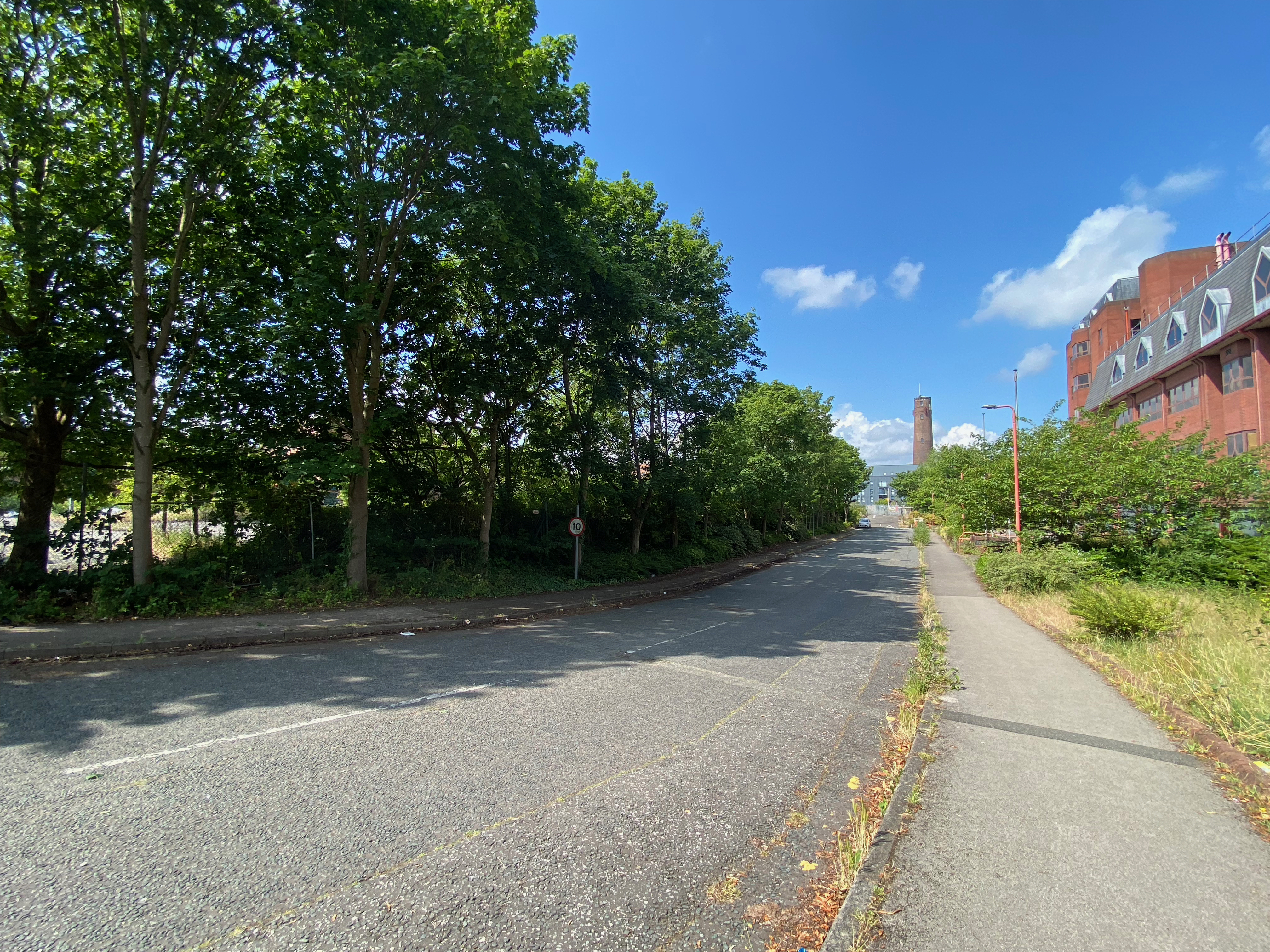
As an afterthought I went down to the area to see if I could get a couple of photographs to accompany the article. The old Lead Works Field is currently covered by two derelict office blocks and an overgrown car park and is for sale although the area available is now 4.34 acres. It did occur to me that if there are any multi-millionaires with money to burn and a huge amount of imagination it would still make a terrific but impractical site for a Stadium, minus a cycle and running track of course.
The old Lead Works Field currently For Sale giving a good view of the area sandwiched by the railway and canalThe junction of Hoole Lane, Station View Road and Westminster Road where one of the entrances to the Athletic Ground would have been locatedLooking down Charterhall Drive across the centre of what was the Lead Works Field
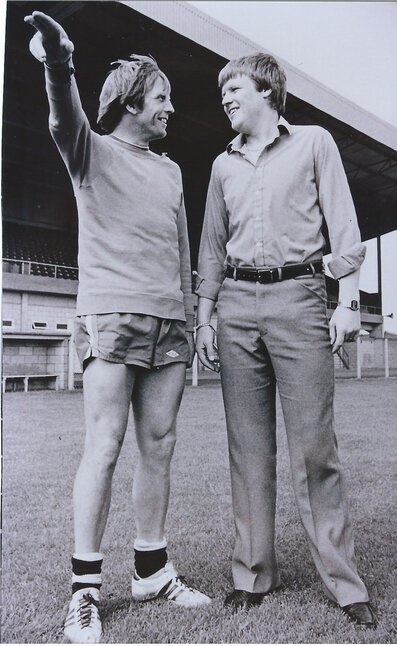
John Sainty, who has sadly passed away at the age of 77, served Chester as manager for 12 months between November 1982 and November 1983. When John was appointed he was faced with the unenviable task of managing a club at one of its lowest ebbs as severe financial constraints affected many decisions. In many weeks he had to rely heavily on non-contract players in order to field a team but he did mastermind two notable victories. In the Milk Cup, in 1983/84, the Seals overcame a 3-0 first round first leg deficit against Bolton Wanderers with an impressive 3-0 triumph at Sealand Road to go through on penalties and this was followed, in the second round, by a first leg 1-0 win over second tier Leeds United at Elland Road with a goal from Andy Elliott.
John started his footballing career as an apprentice at Tottenham Hotspur before going on to play in the Football League with Reading, Bournemouth, Mansfield and Aldershot. After serving on the coaching staff at Norwich he moved with John Bond to become assistant at Manchester City and Burnley before replacing Cliff Sear at Sealand Road. Initially appointed as ‘caretaker coach’ for a six week period this role was extended until Easter when he was finally confirmed as manager. Chester finished the season in 13th place, a respectable achievement given the financial economies which had seen John lose two members of his coaching staff, Jim Walker and Vince Prichard.
For the 1983/84 season the newly renamed Chester City faced even deeper financial problems and after losing leading scorer John Thomas to Lincoln John also had to contend with an even lower budget as the wage bill was slashed in half. Although he did bring in future Welsh international Andy Holden it was a measure of how difficult the situation was by the fact that two players, Paul Raynor and Trevor Phillips, rejoined the club after being released when Chester had been relegated in 1982.
A season of struggle was inevitable and with only one league John was relieved of his duties with Chester bottom of Division Four.
John went on to serve Glossop North End and Mossley as a manager before serving as assistant manager at Stockport County and then moving back down south to become Academy Director at Southampton and managing Lymington & New Milton and Bemerton Heath Harlequins in the Wessex League.
A recent request for a list of Chester’s highest attendances prompted me to look through the records and expand the search to find the top 20. I thought the results might provide interesting reading:
1 – 20,378 Chelsea FA Cup 3rd Round replay 18/01/52 L 2-3
2= 19,000 Leeds United League Cup 4th Round 13/11/74 W 3-0
2= 19,000 Newcastle United League Cup 5th Round 18/12/74 W 1-0
2= 19,000 Aston Villa League Cup Semi-Final 22/01/75 D 2-2
5 – 18,816 Sheffield Wednesday FA Cup 4th Round replay 25/01/39 D 1-1
6 – 18,706 Stoke City FA Cup 4th Round 25/01/47 D 0-0
7 – 18,251 Newcastle United FA Cup 3rd Round 22/01/66 L 1-3
8 – 18,004 Wrexham Division 3 North 29/08/36 W 4-1
9 – 18,000 Plymouth Argyle FA Cup 3rd Round 11/01/47 W 2-0
10 – 16,835 Wrexham Division 3 North 04/02/33 L 0-3
11 – 16,375 Tranmere Rovers Division 3 North 28/03/36 D 1-1
12 – 16,283 Wigan Athletic FA Cup 2nd Round 04/12/65 W 2-1
13 – 16,160 Wrexham Division 3 North 28/02/48 W 4-1
14 – 15,882 Derby County FA Cup 3rd Round 02/01/71 L 1-2
15 – 15,255 Stockport County Division 3 North 24/04/37 D 1-1
16 – 15,202 Wrexham Division 3 North 01/10/55 W 2-1
17 – 15,106 Wrexham Division 3 North 29/09/34 W 6-2
18 – 15,024 Wrexham Division 4 26/12/69 W 2-0
19 – 14,921 Wrexham Welsh Cup Final 03/05/33 W 2-0
20 – 14,782 Wrexham Division 4 27/02/65 W 6-1
I have seen various figures quoted for the Chelsea FA Cup tie in 1952 but have gone for the more precise figure of 20,378 rather than the rounded up one of 20,500 that is often used. I have also little doubt that the attendances of 19,000 for all three League Cup ties were probably based on the capacity of the ground at the time rather than a fully accurate total.
Given that there is a general belief that Chester always lose when there is a larger than expected attendance It is interesting to see that only four of the top 20 games resulted in defeat and three of these were against teams at least two divisions higher.
When Matt Sargent scored after 87 seconds with his first touch of the ball against Kettering Town the question was asked if a Chester player had ever scored a quicker goal on his league debut.
The previous record holder for the reformed club was Johnny Hunt who scored after 4 minutes in the first game of the 2015/16 season when Chester beat Braintree Town 1-0.
Special mention should be made to Jamie Menagh who scored in the 8th and 10th minute in a 4-1 win over Lincoln City in December 2013 while Akwasi Asante scored a hat trick in 69 minutes against Darlington in December 2018 on his debut.
The following table is a definitive list of goalscoring league debutants since the club reformed in 2010 with the quickest first.
Matt Sargent v Kettering Town 19/3/22 – 87 seconds
Johnny Hunt v Braintree Town 8/8/15 – 4 minutes
Wayne Riley v Kidderminster Harriers 25/8/14 – 5 minutes (substitute 78 score 83)
Rob Hopley v Warrington Town 24/8/10 – 6 minutes
Jamie Menagh v Lincoln City 21/12/13 – 8 minutes
James McCarthy v Skelmersdale United 20/11/10 – 11 minutes (substitute 72 score 83)
Jordan Archer v Barrow 24/10/17 – 11 minutes
Brendon Daniels v Vauxhall Motors 23/2/13 – 12 minutes
Luke Holden v Whitby Town 12/11/11 – 14 minutes
Matt McNeil v Rushall Olympic 13/8/11 – 14 minutes
Matt McGinn v FC United 24/8/11 – 17 minutes
Levi Mackin v Rushall Olympic 7/1/12 – 17 minutes (substitute 73 score 90)
Danny O’Brien v Altrincham 16/2/16 – 26 minutes
Akwasi Asante v Darlington 1/12/18 – 27 minutes
Jack Redshaw v Blyth Spartans 25/9/21. – 27 minutes (substitute 59 score 86)
Chris Simm v Ossett Albion 22/1/11 – 43 minutes
James Caton v Grimsby Town 12/4/14 – 45 (substitute 45 score 90)
Okera Simmonds v Curzon Ashton 22/1/22 – 47 minutes
Matty Taylor v Welling United 1/2/14 – 55 minutes
Declan Weeks v Kidderminster Harriers 6/10/20 – 57 minutes
Cain Noble v Maidstone United 21/4/18 – 58 minutes
Jerome Wright v Burscough 17/8/11 – 62 minutes
Danny Williams v Vauxhall Motoirs 30/10/12 – 65 minutes






 Chester Football History