Having reached the FA Cup 1st Round, and facing Football League opposition for the first time since 2014/15, I thought it would be interesting to look at the FA Cup statistics for Chester managers over the years.
It is obviously difficult to make a direct comparison between the pre- 2010 Chester and reformed Chester FC that has only entered the competition at the Qualifying Round stages but it is still interesting to see that Calum McIntyre has now managed the club in 18 FA Cup ties prior to the Cambridge United game. This puts him 4th behind Frank Brown, Ken Roberts and Harry McNally while his win record puts him level with Alan Oakes and one behind Frank Brown.
Prior to 1930 the team was picked by committee so Frank Brown and Harry McNally hold the record for most FA Cup ties managed in a season. During the 1938/39 campaign Chester played seven ties under Brown beating Second Division Coventry City on the way and taking Second Division Sheffield Wednesday to a second replay in the 4th Round. Harry McNally also managed the club in seven ties, during 1986/87, including three games against Rotherham United before coincidentally being eliminated by Sheffield Wednesday in a 4th Round replay.
Alan Oakes has arguably the most impressive FA Cup record with 10 victories in his 17 games in charge. This includes taking Chester to the last 16 on two occasions, in 1976/77 and 1979/80. Both these campaigns featured victories over teams in a higher division, Luton Town in 1976/77 and Newcastle United in 1979/80. Since reforming in 2010 the only times Chester have beaten teams from a higher division has been under Steve Burr (Southend United 2014/15) and Calum McIntyre (Hartlepool United 23/24 and Morecambe 25/26).
Only three managers have achieved victories over clubs two divisions higher. In 1969/70 Fourth Division Chester beat Second Division Bristol City 2-1 under Ken Roberts. In 2000/01 Graham Barrow’s Conference side beat third tier Oxford United 3-2 while two seasons later Mark Wright’s Blues beat another third tier team, Colchester United at Layer Road. This remains the only occasion that Chester have beaten a team two divisions higher away from home so Calum has the chance of equalling this record at Cambridge.
The worst FA Cup record belongs to Louis Page who managed the club in three ties over three seasons in the mid 1950s and lost them all.
Manager
First FA Cup Season
Last FA Cup Season
Played
Won
Drawn
Lost
Furthest Round
CHESTER/CHESTER CITY
Charlie Hewitt
1930/31
1935/36
16
8
2
6
4Rr
Alex Raisbeck
1936/37
1937/38
3
1
0
2
4R
Frank Brown
1938/39
1952/53
24
11
5
8
4Rr2
Louis Page
1953/54
1955/56
3
0
0
3
1R
John Harris
1956/57
1958/59
8
2
3
3
2Rr
Stan Pearson
1959/60
1961/62
5
2
0
3
2R
Bill Lambton
1962/63
1962/63
1
0
0
1
1R
Peter Hauser
1963/64
1967/68
11
6
0
5
3R
Ken Roberts
1968/69
1975/76
24
9
7
8
4R
Alan Oakes
1976/77
1981/82
17
10
1
6
5R
John Sainty
1982/83
1982/83
2
0
1
1
1Rr
Trevor Storton
1983/84
1983/84
1
0
0
1
1R
John McGrath
1984/85
1984/85
1
0
0
1
1R
Harry McNally
1985/86
1991/92
21
8
6
7
4Rr
Graham Barrow
1992/93
1993/94
6
2
2
2
3R
Mike Pejic
1994/95
1994/95
2
1
0
1
2R
Kevin Ratcliffe
1995/96
1998/99
7
3
0
4
3R
Terry Smith
1999/2000
1999/2000
4
2
1
1
3R
Graham Barrow
2000/01
2000/01
5
3
1
1
3R
Steve Mungall
2001/02
2001/02
1
0
0
1
4Q
Mark Wright
2002/03
2003/04
5
3
0
2
2R
Ian Rush
2004/05
2004/05
3
2
0
1
3R
Keith Curle
2005/06
2005/06
4
2
1
1
3Rr
Mark Wright
2006/07
2006/07
5
1
2
2
3Rr *
Bobby Williamson
2007/08
2007/08
1
0
0
1
1R
Simon Davies
2008/09
2008/09
1
0
0
1
1R
Jim Harvey
2009/10
2009/10
2
0
1
1
4Qr
TOTAL
183
76
33
74
* – Chester lost to Bury in the 2nd Round but were reinstated after Bury played an ineligible player
Chester have not received much luck in recent seasons when it comes to the FA Cup and it was no surprise when they were handed a trip to Worksop in this season’s 2nd Qualifying Round. In the nine seasons and 13 FA Cup draws since reforming they have had to travel nine times and only been pulled out of the hat first on four occasions.
Even when drawn at home they have only managed to win one tie and that was two seasons ago when City of Liverpool were convincingly beaten 4-0. On the other occasions, Gateshead won at the Deva Stadium in 2013/14 while matches against FC Halifax in 2012/13 and Altrincham in 2019/20 both finished all-square with Chester losing the away replay. Two other FA Cup matches have been played at home as a result of drawn games at Gainsborough Trinity (2012/13) and Barnsley (2014/15). In the first case Chester came out on top after extra time while Barnsley were comfortable 3-0 winners after the heroic goalless draw at Oakwell.
Regardless of whether the Blues have been drawn at home or away the FA Cup record has been nothing to shout about with only four wins against the aforementioned City of Liverpool and Gainsborough alongside the thrilling away wins at Stockport County and Southend United in 2014/15.
While the reformed Blues may not have had much luck in the FA Cup the previous incarnation of the club had a remarkable run of good fortune against non-league teams after joining the Football League in 1931. Although they were beaten 2-1 at Darwen in the 2nd Round in 1931/32 the draw favoured them in subsequent campaigns and over the next 50 years they were drawn against non-league opponents on 13 occasions with every single one played at Sealand Road. It wasn’t until 1981/82, when they were beaten at Penrith, that they received another away draw at a non-league ground.
The full record reads as follows:
1932/33 – Yeovil & Petters United W 2-1
1934/35 – Dinnington Athletic W 4-1
1947/48 – Bishop Auckland W 3-1
1949/50 – Goole Town W 4-1
1951/52 – Leyton W 5-2
1958/59 – Boston United W 3-2
1961/62 – Ashington W 4-1
1961/62 – Morecambe L 0-1
1963/64 – Blyth Spartans W 3-2
1965/66 – Wigan Athletic W 2-1
1973/74 – Telford United W 3-2
1978/79 – Runcorn D 1-1 (won replay 5-0)
1979/80 – Workington W 5-1
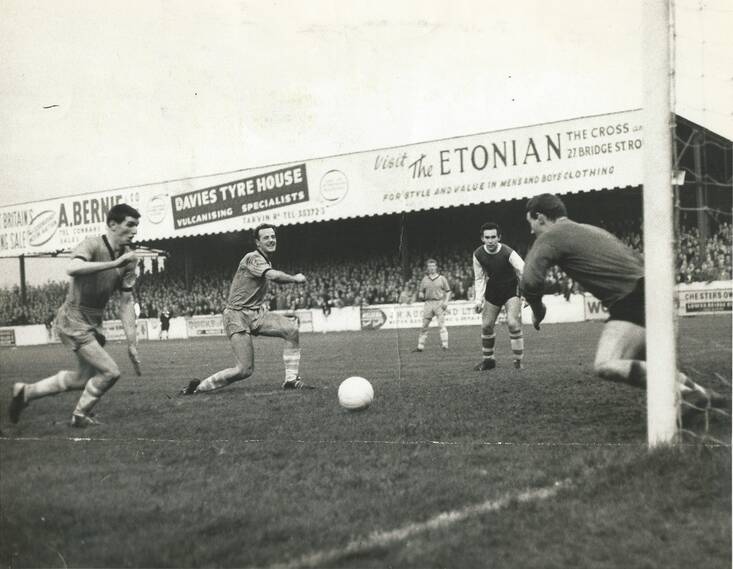
Elfed Morris and Gary Talbot in action during the 3-2 FA Cup win over Blyth Spartans in November 1963 – Chester Chronicle
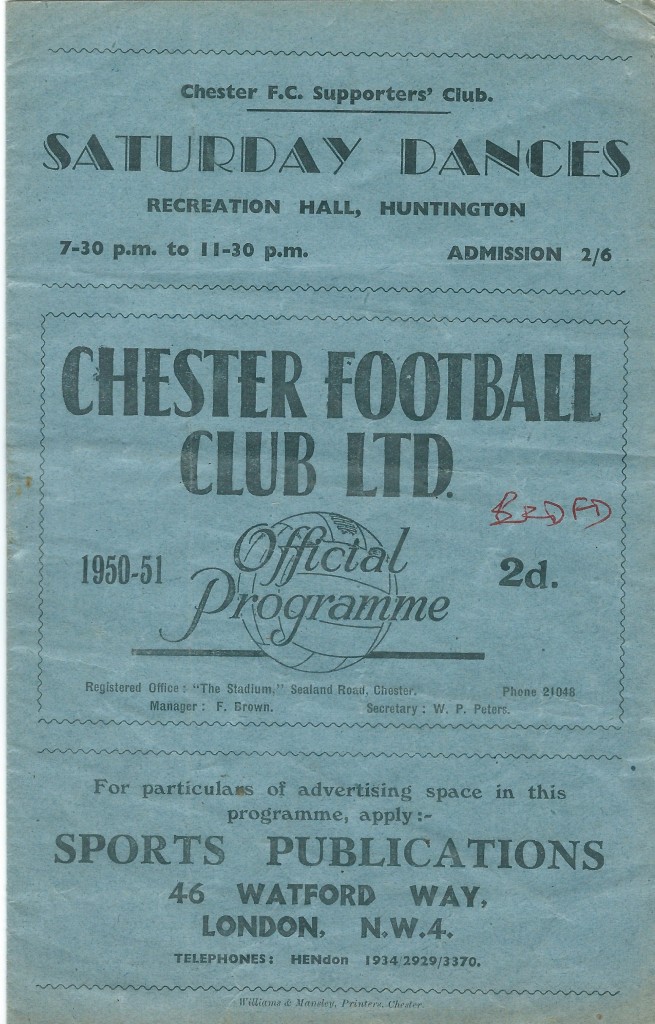
The 1st Round of the 1950/51 FA Cup paired Chester with fellow Third Division North side, Bradford PA. There was little to choose between the teams in the league with the visitors in 8th position and Chester two points behind in 12th place. However Frank Brown’s side were considered favourites having beaten Avenue 2-0 three weeks earlier at Sealand Road in what had been the first ever competitive meeting between the clubs.
The Yorkshiremen had been relegated from Division Two the previous season and this was their first campaign at this level since 1927/28. They had the reputation as a big spending club and the Cheshire Observer noted that over £60,000 had been spent in aggregate transfer fees on those players who had represented the club so far during the season. Perhaps the most notable name in the Bradford team was Jack Haines who had signed from West Bromwich Albion the previous season for £12,000. A pre-war Liverpool player he had won an England cap against Switzerland only two years earlier and had also played for Swansea Town and Leicester City. Despite this pedigree he had been in and out off the Bradford team and had recently asked to be placed on the transfer list.
A more familiar face to Chester supporters was left back Stan James who had made a number of guest appearances at Sealand Road during the war when he was stationed at Blacon Camp. He won a runners-up medal for Chester in the Third Division North Cup Final against Rotherham United in 1946 and the club had hoped to sign him from Bradford but the fee had proved prohibitive.
Bradford had been convincingly beaten in the league encounter at Sealand Road, thanks to first half goals from Tommy Astbury and Geoff Coffin and Avenue manager Fred Emery had recognised that his team had played badly and were capable of far better things. Meanwhile, Frank Brown was quoted in the Cheshire Observer as saying: “We are anticipating a hard game and must not under-estimate Bradford’s cup fighting ability…..We have ground advantage and our own supporters to cheer us on.”
Chester Chronicle cartoon
Unfortunately Chester had failed to build on their commanding performance league win against Bradford. It had been followed by a 3-1 defeat at top of the table Tranmere and then a dismal home showing against Barrow resulting in a 2-1 setback. Frank Brown had boldly experimented by playing three centre forwards against Barrow. Ralph Morement, Tommy Tilston and Geoff Coffin had all donned the number 9 shirt during the campaign but the experiment failed to pay off as Chester wasted a host of chances to give the visitors their first away win of the season.
The big news in the week leading up to the game was the transfer of goalkeeper Ted Elliott to Halifax Town. The former Wolves man, had picked up an early season injury and lost his place to Harry Threadgold who had seized the opportunity with both hands and put in some brilliant performances. As a result Elliott had asked to be put on the transfer list and the deal was completed two days before the cup tie. Tattenhall-born Threadgold was not the only local player to be making the news as Cestrians Tilston and Coffin both signed professional terms prior to the Barrow game after being part-time at Sealand Road since 1944 and 1946 respectively.
There was no special training for the players before the cup tie which had a 2:15 kick-off.
2 – The Match
After the failure against Barrow, Frank Brown took a pragmatic approach for the cup tie by reverting to the same side that had defeated Bradford in the league game three weeks earlier. Jimmy Hankinson and leading scorer Albert Burgess were both recalled while Geoff Coffin took over the number 9 shirt from the injured Tommy Tilston and utility man Ralph Morement dropped to the reserves.
Despite taking an early lead Chester succumbed to a much improved Bradford team who had lost their three previous matches. In the end Chester were perhaps unlucky not to draw and were left to rue Frank Hindle’s missed penalty with the score at 1-1.
Geoff Coffin
Chester got off to a perfect start and took the lead in 4 minutes when Coffin headed in a cross from Les Devonshire. Instead of building on the lead Chester surrendered the initiative and allowed the visitors back into what developed into an end to end encounter. Bradford came close to scoring when Hindle cleared a John Smith shot off the line with Harry Threadgold out of position while, at the other end, Mitchell Downie pushed away a Devonshire free kick and a fierce drive from the same player just passed wide of the post.
In the 29th minute Bradford capitalised on Chester’s failure to extend their advantage when the ever dangerous Billy Elliott came inside to head a Bill Deplidge cross past Threadgold. Chester had the perfect opportunity to regain the advantage on the stroke of half-time when Arthur Wheat was harshly adjudged to have handled the ball. Hindle was the man who stepped up to take the penalty but his weak effort passed wide of the post. The decision to hand responsibility to the normally reliable full-back was questioned by the Chester Chronicle who pointed out that this was his first ever penalty kick.
Bradford took the lead in the 66th minute when Smith headed down an Elliott cross for Deplidge whose shot gave Threadgold no chance. The Yorkshire side also struck the crossbar while Threadgold made a good save from Smith. Meanwhile Downie saved well from Astbury and both Burgess and Coffin missed good chances when well placed. The best opportunity for an equaliser came in the later stages when Billy Foulkes went on a mazy run from his own penalty area and slipped the ball to Coffin who shot straight at Downie. Bradford had to contend with a number of goalmouth scrambles but Downie continued to make some excellent saves and Chester were left to face an early cup exit.
Bradford’s outstanding player proved to be outside-left Billy Elliott who caused problems all afternoon with a brilliant exhibition of wing-play which right-back John Molyneux could not match. While an uncoordinated Chester defence struggled to cope with a potent Bradford strike force the visitors proved stubborn at the opposite end with centre half Les Horsman particularly dominant. Wingers Devonshire and Foulkes were arguably Chester’s best forwards but they lacked service with neither Burgess and Hankinson being particularly effective. Wing-backs Tommy Astbury and Peter Greenwood were not as impressive as usual and Coffin should have scored more than one goal had he displayed more steadiness.
The attendance of 8,255 drew gate receipts of £701.
Chester’s defeat cost them a meeting with the man who had lead them into the Football League in 1931. Charlie Hewitt had moved to Millwall after leaving Sealand Road in 1936 and the London side were drawn against Bradford in the 2nd Round. Hewitt’s side went on to win this encounter after a replay. In the league Bradford climbed to 6th place, seven places above Chester who struggled to maintain any consistency and neither troubled the top or bottom of the table.
Astonishingly the 1st Round elimination was the first time that Chester had been defeated at this stage of the competition since a defeat to Lincoln City in 1890.
Chester Chronicle cartoon
Bradford man of the match, the promising Billy Elliott, had asked to be put on the transfer list before the FA Cup tie and went on to greater things. The following summer he moved to Burnley for £23,000 and was awarded the first of five England international caps in 1952. He later spent six seasons at Sunderland. Another man on the transfer list at Park Avenue was inside-forward Jack Haines. He remained with the club until 1953, when he was transferred to Rochdale, before signing for Chester in 1955 at the age of 35.
Four players featured in their final FA Cup game for the club. The man who missed the penalty, full-back Frank Hindle, ironically moved to Bradford in the summer after two seasons at Sealand Road. He never managed to find the back of the net for Chester in any of his 81 appearances and, despite making more than 200 appearances for his new club, he also failed to score at Park Avenue. Hindle died in Scotland in 2013.
Former Preston inside-forward Jimmy Hankinson failed to establish himself at Sealand Road and only made 15 appearances for the club. Although he was retained at the end of the season he appears to have left Chester during the summer.
Jimmy Hankinson
Another player who only spent one season at Chester was outside-left Les Devonshire. The Londoner was a regular at outside left and only missed two league games in 1950/51. Like Hankinson he was retained in the summer but returned to London and signed for Crystal Palace where he remained for a further four years. He later played for Margate and Canterbury City and died in Middlesex in 2012. He was the father of future West Ham and England player Alan who has been a visitor to the 1885 Arena in recent years as manager of Braintree Town and Maidenhead United.
Les Devonshire
Another player who signed for Crystal Palace was Birkenhead-born Albert “Cam” Burgess who managed an impressive average of more than a goal every two games at Chester. He was leading scorer in each of his three seasons at Sealand Road and moved to Selhurst Park for £3,000 in September 1951. The nippy forward continued to find the back of the net regularly for Palace including a hat-trick in his 2nd game and 18 in his first 15 league starts. In a four game spell the following season he netted three hat-tricks. In July 1953 he moved back north, to York City for £850, and after one season returned to Cheshire with Runcorn. He died in 1978.
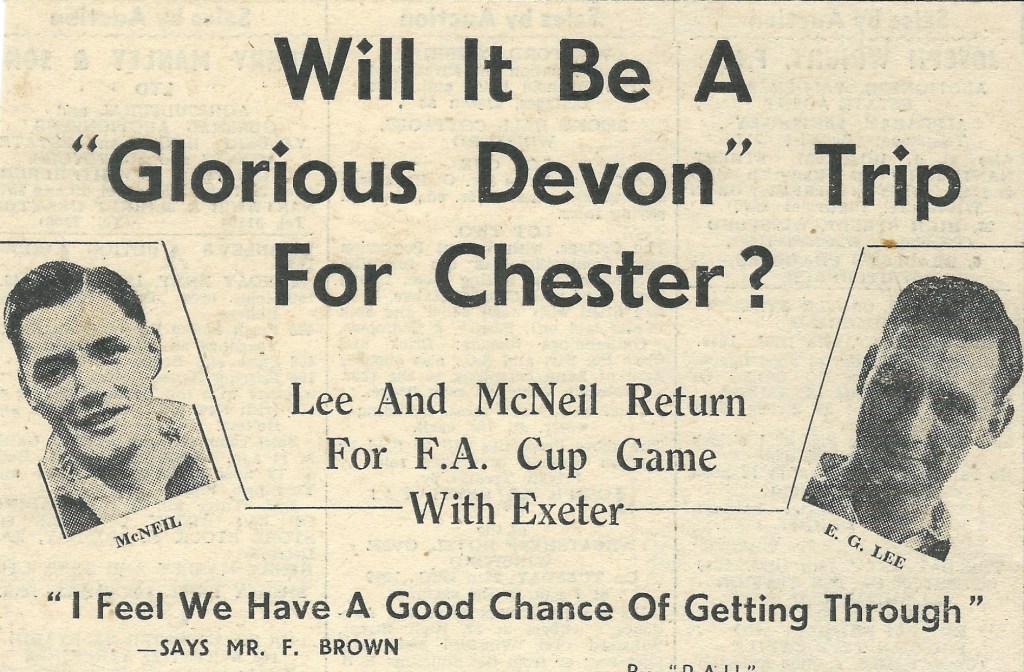
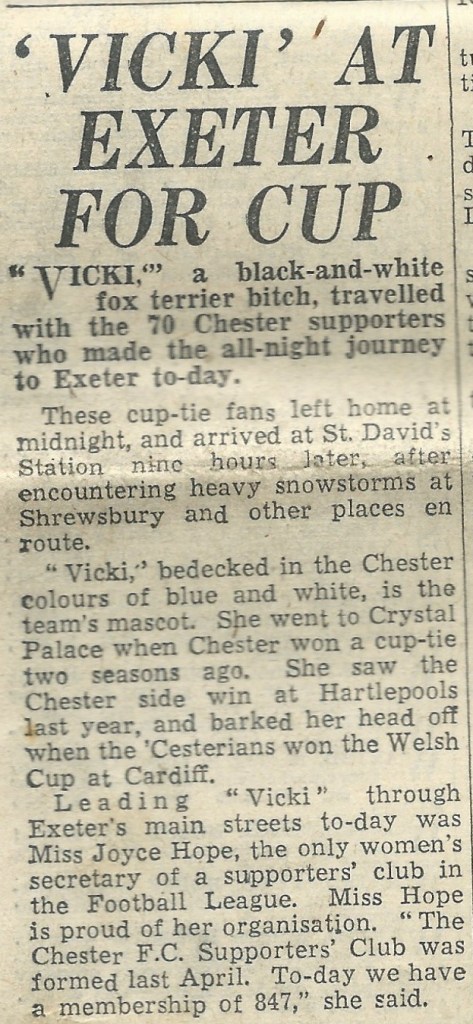
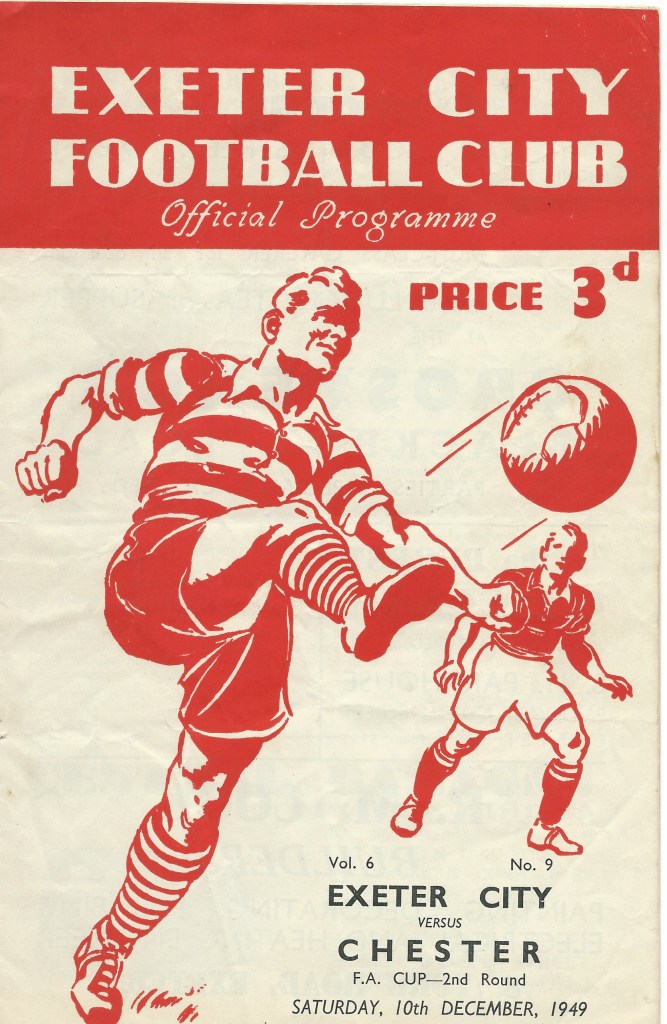
Chester’s reward for their 1st Round victory over Goole Town was a long trip to Exeter City, the furthest distance the club had ever travelled for a fixture. Like Chester, the Grecians were struggling in their league and propped up Division Three South with only 11 points from their 18 league games. They looked particularly susceptible in defence, having conceded 45 goals, and it was reported that they were experiencing the worst season in their chequered history.
Cheshire Observer Headline
Despite the poor league results spirts had been raised in Exeter after a 5-3 win at Millwall in the 1st Round and their manager, George Roughton had proclaimed that: “…if the lads play as well as they did at Millwall on Saturday we shall be in the 3rd Round.” Unfortunately this optimism had quickly evaporated as the Grecians were hammered 7-1 in a league game at Swindon Town the following week. Chester manager Frank Brown had scouted that game and the Chester Chronicle stated that he returned from the game “cock-a-hoop’.
From a personal point of view the tie held additional interest for Brown as he had played a handful of games for the Devon club during the 1921/22 season.
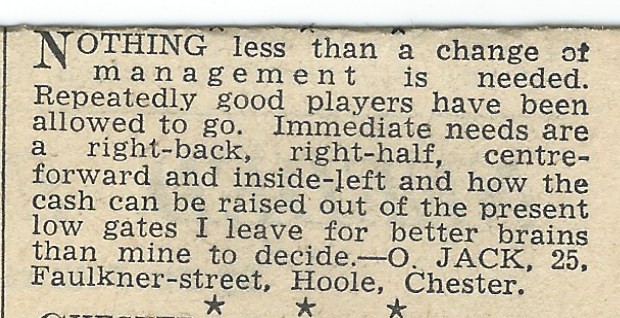
While Exeter had their problems there was also an underlying feeling of discontent at Sealand Road as the club languished in 20th position in Division Three North and displayed a remarkable level of inconsistency. After joining the Football League in 1931 the club had been a top ten fixture throughout the 1930s and this had appeared to carry through the war with a 3rd place finish in 1946/47. Unfortunately, despite some notable FA Cup ties, league form had slumped dramatically and with a 20th position in 1947/48 and 18th in 1948/49 the local papers were increasingly peppered with letters from disgruntled supporters. The day before the cup tie the News Chronicle featured Chester in their “My Team” spotlight under the headline “Down in the Dumps on Deeside.” and a wide range of letters outlined the problems with the current team.
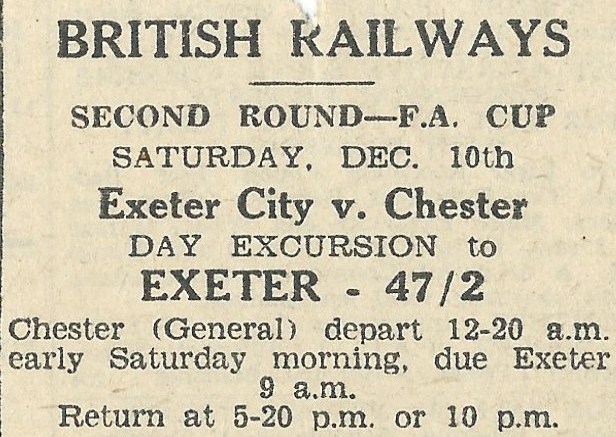
With both teams struggling there was little to choose in what was a closely matched tie. The Chester players did not engage in any special training but as usual there was time for golf at Hawarden and the players set off for Devon by train on Friday morning. Meanwhile the Chester’ Supporters Club arranged a day excursion, leaving at just after midnight on the day of the game and around 70 supporters availed themselves of the 47/2d trip. For those supporters who stayed at home it was arranged for the score at Exeter to be given out at the reserve game against Crewe at Sealand Road every 15 minutes.
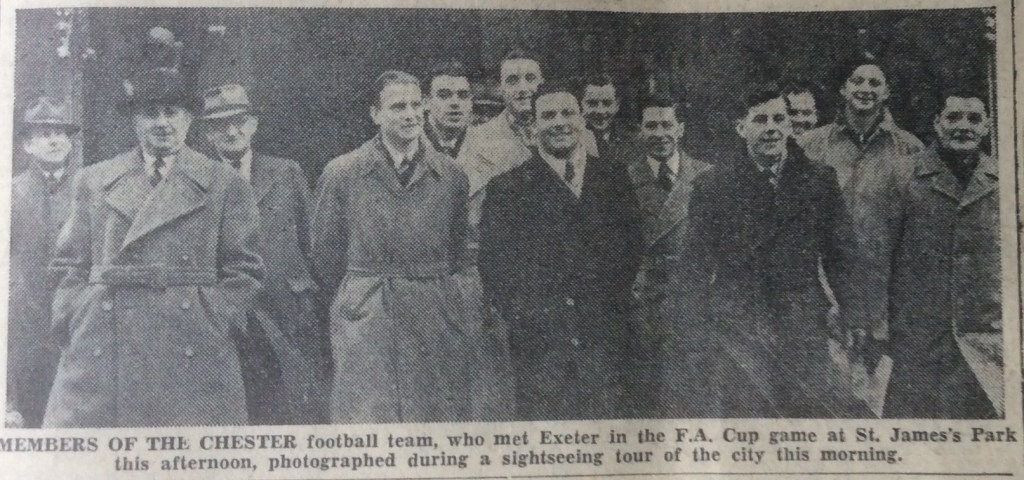
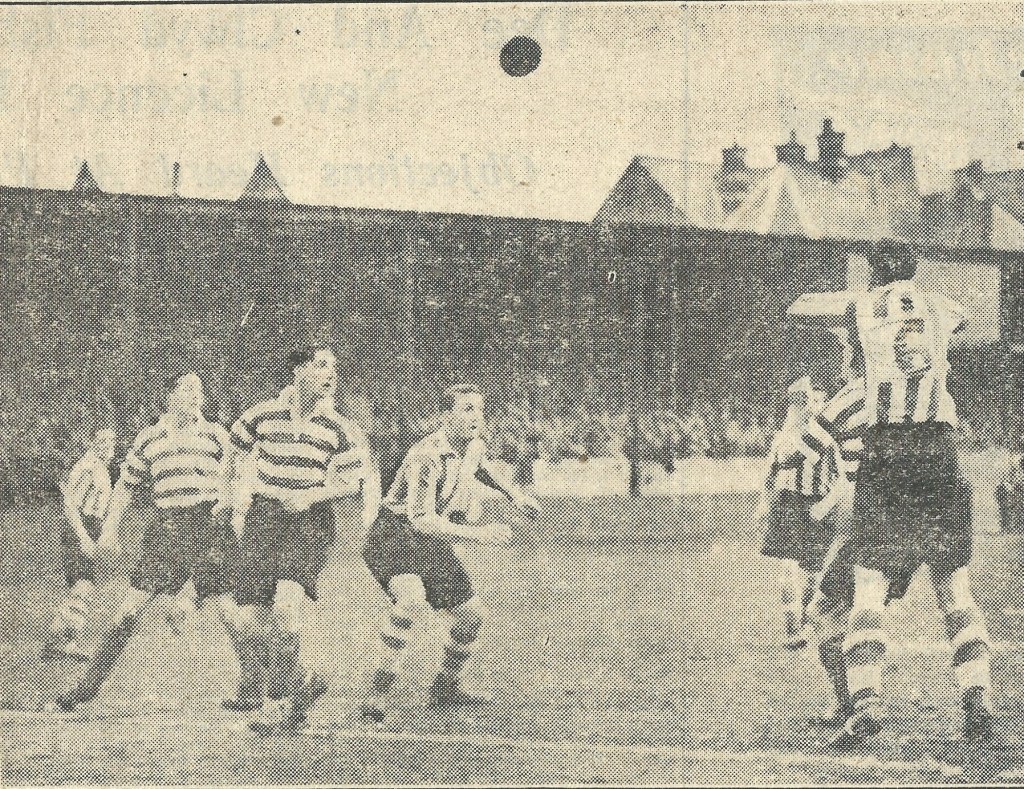
Exeter Express and Echo photograph
Exeter Express and Echo
2 – The Match
In between the Goole and Exeter FA Cup ties Chester had suffered a setback where they failed to take their chances in a 4-2 defeat to Carlisle United at Sealand Road.
While the attack came under fire for their lack of incisiveness there were clearly defensive problems with the left flank in particular singled out for criticism. Against this backdrop Frank Brown elected to move Eric Lee back to the left-half position, where he had made his name in the first season after the war. Meanwhile Dave McNeil, who had played in the Goole FA Cup tie, replaced Reg Butcher who had struggled in the problematic left back role against Carlisle. Frank Hindle, who had been signed as a left-back continued at centre half, a role he had taken after Lee’s call-up for England amateur duties.
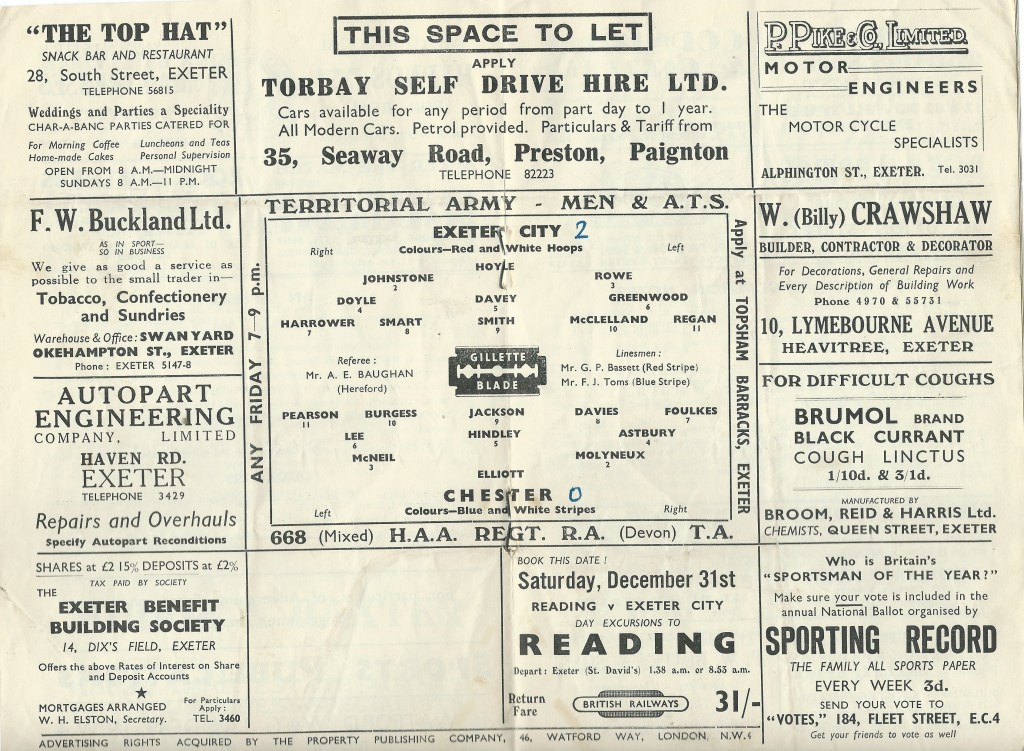
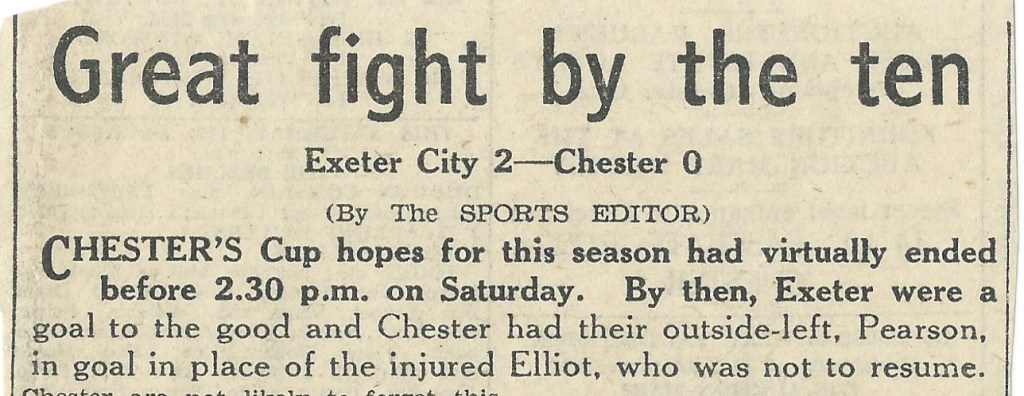
Despite the defensive changes the tie was as good as decided in the first 15 minutes as Chester conceded an early, sloppy goal and then were unfortunate to lose goalkeeper Ted Elliott to concussion shortly afterwards. The loss of Elliott saw winger Bill Pearson take over in goal as Frank Brown’s team played the remainder of the game with only 10 men. Even with this handicap the team acquitted themselves well and played the better football so Exeter’s late penalty and the 2-0 scoreline slightly flattered the home side.
Chester Chronicle Headline
Exeter started the game brightly and produced their best football in the first 15 minutes. After only four minutes defensive lapses cost Chester dearly as Lee and McNeil failed to deal with right winger Bill Harrower who had all the time in the world to get in his cross. With Elliott static on his line and full back John Molyneux hesitant, Duggie Regan finished expertly to give the home side the lead.
It was a goal that should have been prevented and Chester responded quickly as Harry Jackson’s first-time drive was blocked by a defender with keeper Bert Hoyle beaten.
Ted Elliott Chester Chronicle Image
Worse was to follow for Chester on eight minutes when Molyneux missed a tackle and keeper Elliott received a kick on the back of the head as dashed out to save the situation. After a few minutes attention the former Wolves man returned but it was clear he was in no fit state to continue and outside left Pearson took over in goal.
Despite this setback Chester continued to have their fair share of the play and winger Jackie Davies, the pick of the forwards, was unlucky not to score when he set off on a dazzling run through the Exeter defence only to shoot a few inches wide from ten yards. Davies continued to cause the home side problems with his tricky running and he almost scored an equaliser before half time but his shot was blocked by Stan Rowe.
Chester continued to take the fight to Exeter in the second half but despite good work from Tommy Astbury, Billy Foulkes and Davies the forwards were not able to take advantage and few clear opportunities were created. Albert Burgess did get the ball into the back of the net on two occasions but both were rightly disallowed for offside. Chester’s best opportunities came from corner kicks and centre half, Frank Hindle was particularly unlucky when his towering header was blocked on the line by Leslie Doyle with keeper Hoyle nowhere.
Hindle, who had an outstanding game, was also a threat marauding out of defence and he was unlucky on one run when he was blocked by his own player Burgess when running through on goal. It was therefore unfortunate that the former Blackburn defender was culpable for Exeter’s second goal two minutes from time when he upended Archie Smith with an over-enthusiastic challenge.
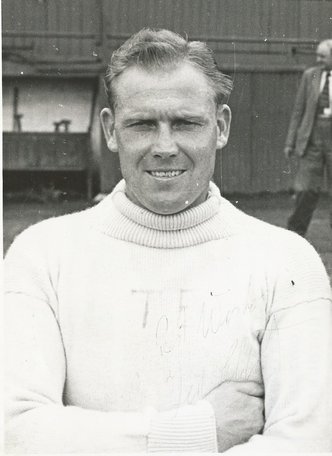
Bill Pearson
Regan scored from the resulting penalty with a mishit shot that went where neither he or stand-in keeper Pearson expected. Talking about the penalty after the game Pearson said “I went to the left. Regan told me as we came off that he had miskicked and the ball went to my right instead of to the left as he intended.”
It was a shame for Pearson that he was unable to keep a clean sheet after such a confident display. His jumping, diving and one remarkable save from Charlie McLelland was appreciated by the Exeter crowd who sportingly applauded him off the pitch at the end of the game. The former Grimsby man admitted that he was no stranger to the role having represented the RAF in goal and he also confessed that it was his favourite position.
Despite Pearson’s heroics it was a game that Chester didn’t deserve to lose and even with only 10 men they created enough chances to win the game. If they had remained at full strength they would have beaten what was considered a moderate Exeter side.
While Chester were unlucky to be eliminated from the competition they had at least gone down fighting. The following week they suffered another defeat, this time 3-0 at Stockport County, and this result prompted another defensive reshuffle. Hindle returned to the left back role and Eric Lee was reinstated at centre half, a move that appeared to stabilise the team as results improved in the second half of the campaign. In the end Chester recovered to 12th position with only four defeats after January 1st.
Exeter were drawn against non-league Nuneaton Borough in the 3rd Round and comfortable beat the non-leaguers 3-0. In the 4th Round they received a plum draw against Liverpool at Anfield where they were beaten 3-1. Back in the league results improved in Division Three South and they hauled themselves off the bottom to finish the season in 16th position.
Despite his concussion Elliott returned to the team at Stockport the following week and surprisingly didn’t miss a league game in 1949/50. Although he started the first two games the following season he was displaced by promising young keeper Harry Threadgold before joining Halifax Town in November 1950. He died in 1984.
Dave McNeil Chester Chronicle Image
Dave McNeil also played in the defeat at Stockport County but this proved to be his last league game of the campaign. It was 12 months before his next appearance, one of only six in 1950/51, and in 1951 he moved to Holywell Town for two years before a season at Northwich Victoria and three at Colwyn Bay. A product of local football he had initially signed as an amateur of Chester in 1938 and his loyalty was rewarded with a testimonial against an Everton X1 in 1951. Always remembered as the full-back who tamed Stanley Matthews in the 1947 FA Cup tie at Stoke City he died in 1993.
The promising Jackie Davies, who had performed so well at Exeter, suffered a badly fractured leg in a league game at Bradford City only two weeks later. Although the 23 year old forward briefly returned to the team at the start of the 1951/52 season the injury effectively ended his career. He died in 1973.
Jackie Davies Chester Chronicle Image
Centre forward Harry Jackson, who had scored a hat-trick against Goole Town, found himself edged out of the side in the second half of the campaign when he lost his place to local lad Geoff Coffin. He was released at the end of the season and signed for Hyde United. The former Manchester City and Preston player died in 1984.
Hero of the day Bill Pearson only played 12 league games for Chester before a persistent knee injury forcing him into retirement from the professional game at the end of the 1949/50 season. The Irishman continued to play amateur football in Yorkshire and died in 2009 after a long illness.
After five consecutive away ties Chester finally received a home draw for the first time since hosting Bishop Auckland in the 1st Round in 1947. They were the first team out of the bag and paired with the winners of the Goole Town v Scunthorpe United tie which had finished goalless the previous Saturday. Both teams were in the Midland League but top of the table Scunthorpe remained favourites to go through against a side who were bottom of the table with only five points from 13 games.
The replay took place the following Saturday and manager Frank Brown travelled to Goole to watch the game which was abandoned, due to fog, with 15 minutes to go. The home side had been winning 3-1 and the scoreline was repeated the following Monday as Goole sprung a major surprise to reach the 1st Round for the first time since 1915.
Chester Chronicle headline
Remarkably, the Chester tie was scheduled to be Goole’s 10th in the competition that season with four of their Qualifying Round ties needing replays. Having comfortably beaten Barton Town in the Preliminary Round they had needed replays to dispose of Frickley Colliery, Bentley Colliery, Brodsworth Main and Scunthorpe.
The extended cup run partially explained why Goole were rooted to the bottom of the Midland League having played far fewer matches than everyone else. Frank Brown was keen to say that he wouldn’t take the opponents lightly and reported that: “They are a strong workmanlike side who believe in the direct approach to goal.”
Cheshire Observer headline
The part-time visitors had every reason to be confident as Chester themselves were having an up and down season and languished in 17th place although they had beaten Lincoln City 3-1 at Sealand Road the previous week. This improved performance had come on the back of four consecutive defeats and the club were keen to have a good cup run to revive the flagging enthusiasm of supporters.
Frank Hindle Image Chester Chronicle
The victory over Lincoln had seen Chester make an enforced change. Eric Lee had missed the game due to an amateur international trial match so Frank Hindle, a summer signing from Blackburn Rovers, had been moved from left back to centre half while long-serving Dave McNeil returned to the team for the first time since the opening week of the campaign. Both were set to retain their positions for the Goole match with Hindle’s sturdy build seen as invaluable against robust opponents.
One other positive for Chester was the form of 18 year old defender John Molyneux. The Warrington-born, England youth international had made his debut against Rochdale in September after two years careful development with the ‘A’ team and reserves. He had replaced veteran Eric Sibley, a summer signing from Grimsby, at right back and was considered to be a very bright prospect.
John Molyneux Image Chester Chronicle
Grenville Booth – Chester Chronicle cartoon
Chester’s only injury concern was on the left wing where another former Grimsby player, Bill Pearson, had picked up an injury against Lincoln. He was expected to be replaced by Grenville “Bunty” Booth, a locally-born school teacher who had made eight league appearances in the 1948/49 season but had yet to feature in the current campaign. Booth had been a regular with the Cheshire County League team but had made his first appearance for the club in wartime football. Although recognised as a half back he was seen as a reliable replacement for Pearson with his height and weight seen as a positive asset against the strong Goole side.
Goole were expected to bring around 1,000 supporters and the game was scheduled to kick off at 2:15pm.
2 – The Match
As expected, Bill Pearson failed to recover from his knee injury and was replaced by Grenville Booth at outside left otherwise Chester lined up with the same side that had beaten Lincoln City the previous week. Meanwhile Goole relied on the same starting eleven that had beaten Scunthorpe in the previous round.
In the end Chester had little difficulty in disposing of their Midland League opponents and once Harry Jackson had put Frank Brown’s team ahead in the first five minutes there was little doubt about the result. Jackson went on to complete a hat-trick as Chester dominated the game and were much the better side. Goole did have a short spell of pressure at the end of the first half but it became a case of how many goals Chester would score.
Chester Chronicle headline
Chester almost opened the scoring in the opening minute. First of all goalkeeper Robert Ferguson had to make a smart save low down from Joe Davies before a smashing drive from Jackson struck the inside of the post and bounced back into play. The respite only lasted until the 4th minute when Jackson collected the ball from Davies and calmly steered the ball past Ferguson.
Harry Jackson
Chester continued to control the game but just before half time Ted Elliott was forced into a brilliant save when he pushed a powerful effort from Pringle round the post.
Early in the second half Brown missed a golden opportunity for Goole before Kimber cleared off the line from Albert Burgess and Ferguson saved well from Jackson. In the 68th minute Chester extended their lead through Jackson and 10 minutes later the centre forward completed his hat-trick when he headed in a Billy Foulkes cross.
Cutts pulled a goal back for Goole, after Brown had hit the post, but the afternoon was rounded off when Burgess added a fourth with two minutes remaining.
It was a comfortable win for Chester and could easily have been more convincing. Grenville Booth did himself justice at outside left and almost scored a couple of goals including a header that hit the underside of the crossbar. Joe Davies also did well at inside right and deserved to be amongst the scorers with two great shots, one of which was brilliantly saved by Ferguson.
Goole Town – Ferguson, Kimber, Rogers, Sherwood, Towle, Pringle, Cutts, Hall, Hunt, Glasby, Brown
Scorer – Cutts 85
Attendance – 6,774
Chester Chronicle photograph
3- Post-match
The attendance of 6,774 was the lowest FA Cup attendance for a Chester game since 1938 when 6,672 attended the 1st Round match against Bradford City at Sealand Road. It was estimated that 500 Goole fans made the journey, half the original estimate, and the receipts were £525.
The FA Cup match marks the only meeting between Chester and Goole.
Harry Jackson became the first Chester player to score an FA Cup hat-trick since Sammy Armes against Darlington in 1933.
Grenville Booth returned to the Cheshire County League side and made no further first team appearances for the club. He went on to play for Colwyn Bay but remained a teacher in Chester. He died in 1990.
The 2nd Round draw handed Chester a long trip to Devon where they faced Division Three South side Exeter City.











 Chester Football History