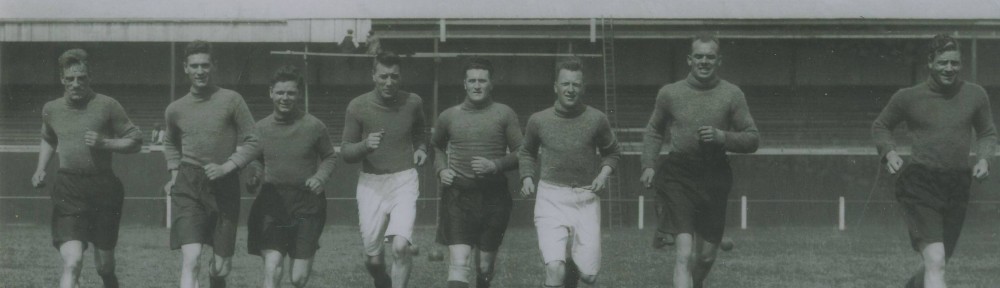
When Charlie Hewitt was appointed as Chester’s first Secretary-Manager in 1930 the club made the decision to go all out for Football League status.
Ambitious plans were put in place with admission prices increased to fund exciting new signings like ex Scottish internationals Dave Morris and Phil McCloy, Bobby Irvine the former Everton and Ireland international and crucially, Arthur Gale from West Bromwich Albion. Gale, a schoolmaster from Bury went on to score 73 goals in 39 league games as the Chester public responded to Hewitt’s exciting team.
With attendances soaring there was a real buzz in the city and the excitement was reflected in ambitious ground developments included completely covering the Sealand Road End and extensions to the main stand.
As part of the push for admission to the Football League the directors personally visited all the 1st and 2nd Division clubs and also produced an impressive 16 page booklet outlining Chester’s case. Priced at one shilling and printed by Taplen and Paddock with a card cover it appears to have been available for general purchase.
The booklet was published in April 1931, after the last home game of the season, and amongst the most fascinating details are a list of attendances and gate receipts for all home fixtures ranked from highest to lowest. Uniquely the table also publishes the weather conditions for each game and it is interesting to note that the game against Nantwich in January was played in heavy snow and still attracted an attendance of 4,043.
Highest attendance of the season was for the top of the table clash against Port Vale Reserves on Good Friday. The game coincided with the unveiling of the extension to the main stand and there were 13,000 in attendance beating the record of 11,507 set only a week earlier when Cardiff City were the visitors for a Welsh Cup 6th Round tie.
The new stand extension can be seen in one of the photos in the brochure and it was during the close season that the stand was further extended towards the Kop. The brochure itself puts the ground capacity at 16,000.
Meanwhile the Sealand Road End had been completely covered and that roof remained in place until 1987. I’m sure many people will remember being showered by rust when a stray shot hit the roof.
Also included in the brochure was information sent by the London Midland and Scottish Railway Company showing rail times and prices to all the teams in the Third Division North. Interestingly the train company states that it would be possible to arrange special trains for nearer places and matches starting late.
The brochure put forward an excellent case with a section on the city itself as well as mentioning how well the ground was served by a frequent bus service and a car park capable of holding 200 cars. As for the ground itself, mention is made of the Grand Stand equipped with electric lighting and telephone along with players’ dressing rooms that were centrally heated and possessing excellent bath accommodation. Accounts also show the club made a profit of £2250 between August 1930 and April 1931.
As a ‘special feature’ attention was drawn to amplifying equipment used to broadcast music and news with the club claiming that this innovation was the first of its kind on any football ground in England.
The booklet clearly helped Chester’s case and two years after they had recorded no votes at all they were elected into the Football League although it needed a second ballot before they took the place of Nelson.
Although the introduction of the training floodlights in 1956 was deemed a success no progress was made towards a more permanent solution over the following two campaigns. The club was still struggling financially, with gate receipts down by the end of 1956, and the Supporters Association were bridging the gap with a range of social functions such as dances.
The big breakthrough occurred in May 1958 when the Supporters Association offered to make an initial donation of £1,500 towards the cost of permanent floodlights. Installation estimates now put the cost at around £12,000 and, even allowing for this generous contribution, it was still seen as beyond the financial capacity of the club. Nevertheless chairman Sam Argyle promised that they would look at alternatives with an awareness that inflationary pressures would only increase costs.
There was now some momentum towards floodlights and there was more positive news a couple of months later when the club announced a profit of £2,616 for the 1957/58 season, despite a large increase in costs. This was largely down to the repeal of the Entertainments Tax as well as donations of over £7,000 from the Supporters Association. It prompted the setting up of a Floodlight Fund with the directors matching the initial donation from the supporters who also handed over another cheque for £350 at the end of 1958 followed by £750 in summer 1959 when the fund reached just under £5,000. Despite the positive funding news the directors still did not feel in a position to progress in 1959 as the club was once again running at a loss and the estimated costs had now escalated to between £16,000 and £18,000. However, with questions been asked about an installation date, the directors said they would start work once the fund reached £10,000.
By the 1959/60 season floodlights were being seen as a necessity rather than a desire and with local rivals, Crewe and Tranmere, both becoming floodlit Chester were one of the few remaining clubs without facilities. It was generally felt, in the days when gate receipts were shared, that they would soon become a mandatory requirement as clubs with lights would complain about smaller gates at clubs without them. At Chester it was thought that the ability to have a later kick-off time and night games could be worth as much as £3,000 a year so, although there was a high initial cost, they would pay for themselves in the long run. As an example a Wednesday fixture against Hartlepool in October 1958, kicking off at 3pm, had a ‘meagre’ attendance of 3,220 compared with the home game against Aldershot the following weekend which attracted 6,655. In addition the chairmen of the Division 1 and 2 clubs were talking about the possibility of running a floodlit cup competition which would effectively exclude the unilluminated teams like Chester.
The Supporters Association continued to drive the project forwards and the weekly lottery fund was reported to have a membership of 11,000 raising around £200 a week for the club. The importance of the group cannot be underestimated and, as well as contributing to the Floodlight Fund, they also funded a new half-time scoreboard, development under the main stand and a donation to cover the cost of a postponed fixture at Gillingham.
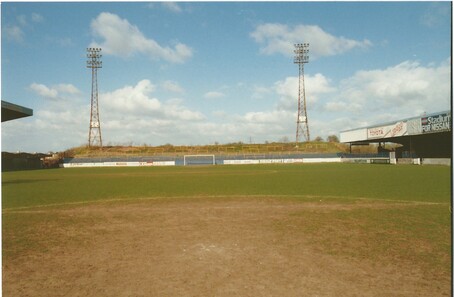
At the end of May 1960 the long awaited announcement was made that the club were in a position to finally go ahead with the installation. The contract was awarded to the Edinburgh engineering company, Miller and Stables Ltd, who undertook to have the lights in place and operating by mid-September. The drench lighting system was considered to be the best available, due to the height of the towers, which were 126ft tall instead of the usual 80ft and it was estimated that the ball could be kicked 50ft in the air without players the players losing sight of it. The delay in installing the lights had worked in Chester’s favour as the 25 degree beam angle towers and intensive lighting easily exceeded the requirements of the Football Association and were considered future proof. The system had first been introduced seven years ago with the first set implemented at Easter Road, Hibernian. Since then they had been installed at Celtic, Newcastle United, Queen of the South, and Windsor Park amongst others while systems at Raith Rovers and Motherwell were completed just before Chester’s.
The fact that the club felt in a position to install the lights was due to another cheque for £5,000 from the Supporters Association who also gave a pledge that no other schemes would be undertaken until the lights were paid for. Nevertheless it was a brave move by the directors on the back of overall losses of over £3,000 in both 1958/59 and 1959/60. When the club released the financial accounts for the 1960/61 season it was revealed that the final installation had cost £15,417.
Cutting the first sod July 20th 1960 – Chester Chronicle photograph
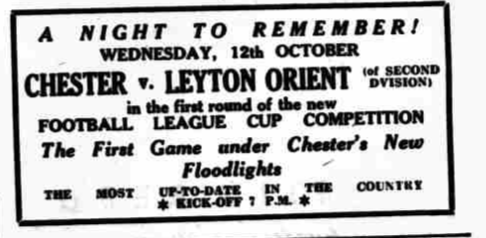
Cheshire Observer advert for the first game under lights
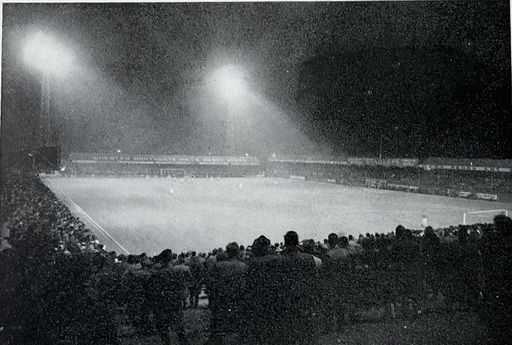
Surveying took place in June and July 1960 while the first sod was cut on Wednesday July 20th and the lights were ready for Chester’s first ever League Cup tie, against Leyton Orient, on October 12th. The official switch on was undertaken by Supporters Association chairman Reg Moore and the crowd of 9,074 was treated to a dramatic cup tie. The Division Two visitors held a comfortable 2-0 lead at half-time but Stan Pearson’s side made a fight of it after the interval and in the final four minutes Ron Davies and Jimmy Cooper scored in a stirring comeback. Chester lost the replay in London by a single goal and there was nothing to celebrate in the league as the club finished bottom of Division Four and had to apply for re-election.
Fortunately the introduction of floodlights gave Chester a good case when they went cap in hand to the League and they finished comfortably top in the re-election vote. In addition there was a boost to finances with friendlies against Manchester United and Third Lanark attracting attendances of 8,673 and 3,621 respectively. However, the novelty of floodlight friendlies quickly wore off and matches against Stirling Albion and German side Hamborn the following year only drew relatively small crowds of 841 and 2,318.
Chester v Manchester United – March 1961
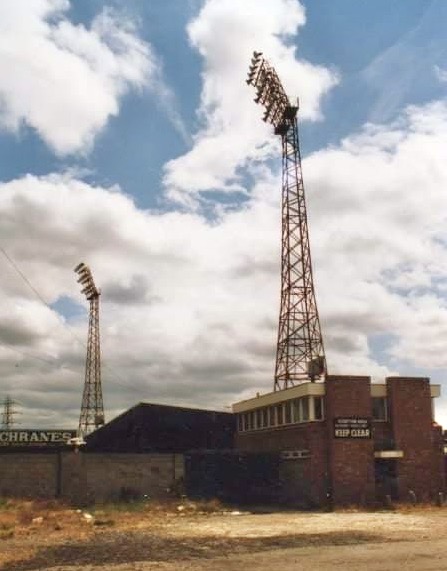
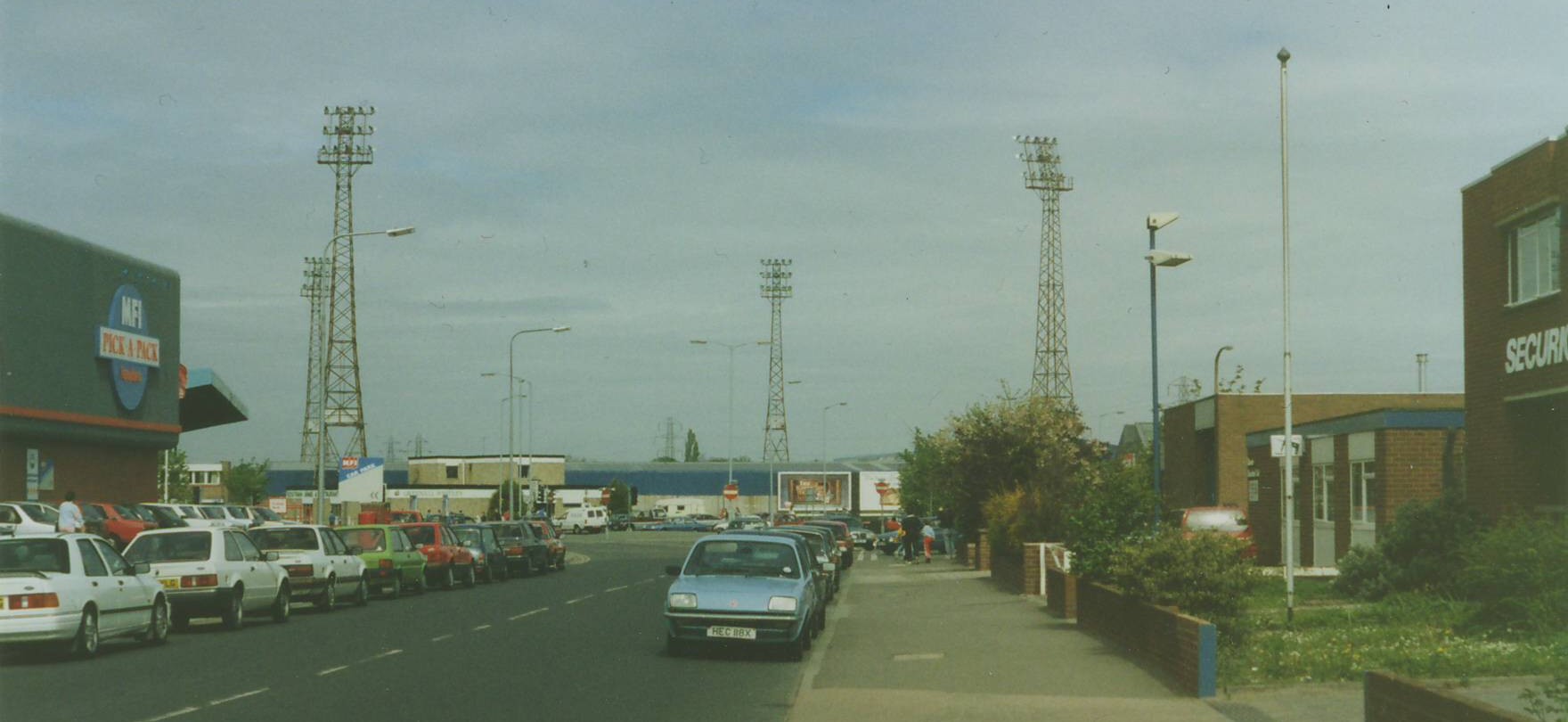
The floodlights remained a landmark until the ground was demolished in 1992 and those supporters who were fortunate to see evening games at the Stadium will fondly remember the approach to the ground down Sealand Road with the giant structures lighting up the area and visible for miles around. Matches under the Stadium lights always seemed to hold a special magic and remain an indelible memory of the 1974/75 League Cup games against Leeds, Newcastle and Aston Villa standing as a tribute to the hard work of the directors and Supporters Association who made it all possible.
League Cup Semi-Final v Aston Villa under the lights in Jan 1975 – Chester Chronicle photograph
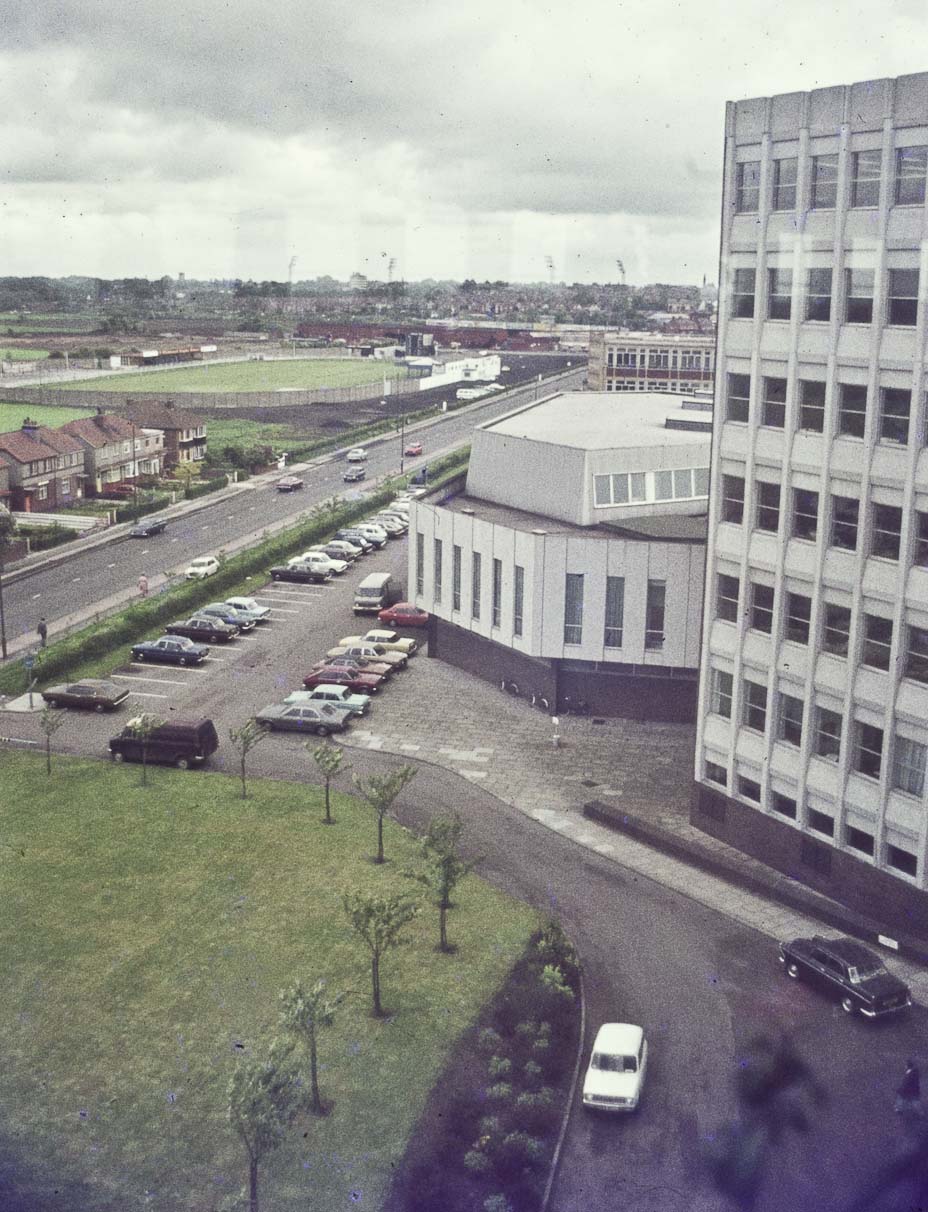
I came across a couple of fascinating photographs of the old Sealand Road ground recently and would like to thank former Manweb employee, Peter Thomas, for allowing me to use them. Peter’s pictures were taken from the top of the old Manweb building which was itself demolished at the turn of the century. I’ve added a couple of my own pictures, taken in 1990, which also show the outside of the ground from a slightly different viewpoint.
The two Manweb pictures show the view looking up Sealand Road towards the city centre. The patch of green on the left of Sealand Road is the Greyhound Stadium with the old football ground just above it. I think that the pictures were taken in the mid 1970s based on the work that appears to be taking place between the two stadiums. I believe that this is the construction of the small industrial estate that was built following the sale of the old training annexe in 1973. It also appears as if the picture was taken before the new office block was built at the front of the ground, around the time of promotion in 1975. You can just make out the old wooden office at the corner of the Main Stand and Sealand Road End. The old wooden main stand was replaced in 1979.
The Greyhound Stadium was itself demolished around 1986 while the football ground was vacated in 1990 and then eventually knocked down in 1992.
The third picture was taken from the inner ring-road in spring 1990 and shows how much the old ground used to stand out on the skyline.
The final picture is taken from Bumpers Lane before the final game against Rotherham United in April 1990.
If anyone else has any further thoughts on the dates of the photos taken from the top of the Manweb building I would be interested to hear any comments.