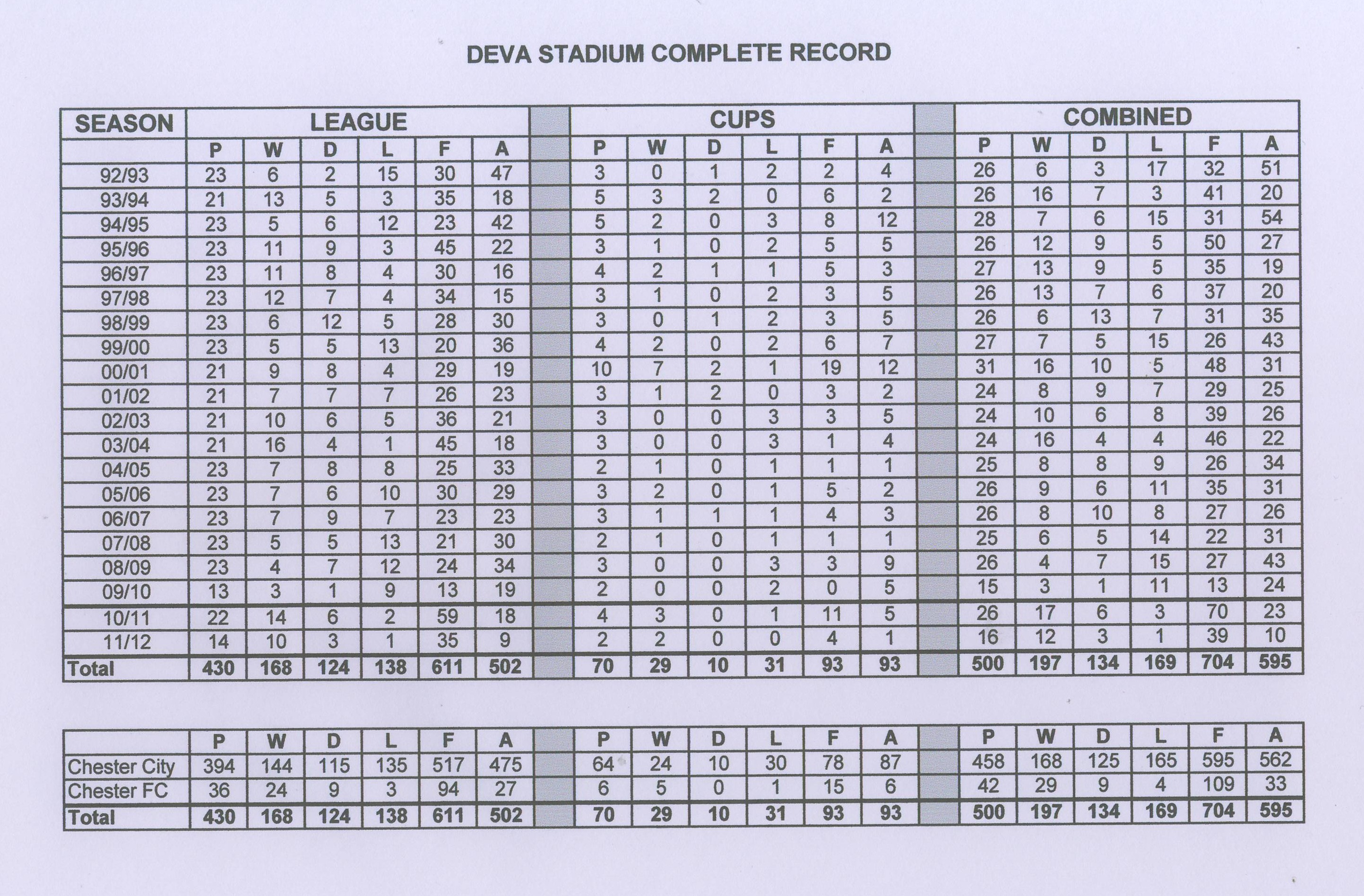
Jack Lipsham and Kevin Roberts

On the face of it there is nothing to connect winger Jack Lipsham, who played for Chester at the start of the last century, and current defender and midfielder Kevin Roberts. However the two players have the distinction of having the longest career span representing the club. In Kevin’s case this has spanned both Chester City and Chester FC, and is still ongoing, but both players have their first and last games for the club separated by 18 years. 

Jack played his first game in the opening game of the 1903/04 season, a Combination fixture against Witton Albion, with his last game coming after the First World War in March 1921. Kevin made his debut in the first away fixture of the 2007/08 season at Rochdale and is, of course, still a regular member of the team in 2024/25.

An outside left John Lipsham, better known as Jack or Jacky, was one of four brothers to play for the club. The most successful of these was Bert Lipsham who represented Chester in 1896 and 1897 and went on to play 235 times for Sheffield United winning an FA Cup winners medal in 1902 as well as an international cap for England. William, who was five years older than Bert, played twice for the club during the 1897/98 season while younger brother Tommy made his debut in 1901 and played at outside right until the end of 1904. The latter’s career overlapped that of his older brother Jack at Whipcord Lane while during the 1902/03 campaign both Tommy and Jack also played for Sheffield United Reserves where their brother Bert was in the first team. 

Jack was born in Chester in October 1881 and started his football career with Chester St John’s in the Chester and District League. At the end of the 1901/02 campaign St John’s were taken over by Chester and run as their reserve team with Jack a regular alongside brother Tommy. In September 1903 he made his first team debut at Whipcord Lane scoring one of the goals in a 5-0 win over Witton Albion. Over the next three seasons he only missed two Combination fixtures and was leading scorer in 1905/06. Although only 5ft 6in tall he was a well-built player and his speed down the wing and accurate crosses attracted the attention of First Division Liverpool who signed him in summer 1906. However, Jack only made three appearances for the Anfield club before returning to Chester the following year. 

By this time the club were playing at Sealand Road and Jack rarely missed a game as the club won the Welsh Cup for the first time in 1908 and the Combination League in 1909. By 1913 he had amassed more than 250 league games, a great achievement given that the number of fixtures per season ranged from only 24 to a maximum 38. In March 1913 the league fixture against Hyde was designated as a benefit for Jack and his colleague Billy Matthews in recognition of their great service and the princely sum of £82-10s was raised. Surprisingly Jack signed for Wrexham during summer 1913 but nevertheless remained a popular figure and returned to Sealand Road after the war when Chester became founder members of the Cheshire County League. He played his last game for the club in March 1921, against Stalybridge Celtic Reserves, at the age of 39 having made more than 300 first team appearances. Jack was also an enthusiastic cricketer and represented Chester St John’s while at the end of his football career he was a cashier clerk at the Army Pay Office and later became general manager of the Chester Steam Laundry in Boughton. He died in 1959. 

Jack Lipsham – (Front Row 2nd from left) – Chester St John’s Cricket Club 1907

Of more recent vintage Kevin Roberts graduated from the Chester youth team and was given his debut by Bobby Williamson in central midfield, having just turned 18, in a 2-1 victory at Rochdale in August 2007. Two weeks later he went on to score his first goal in a 1-1 draw at Rotherham. Over the next three seasons he became an established first team regular making 81 Football League appearances in total. Following relegation he featured in all 28 Blue Square Premier league games in the aborted 2009/10 season and was a member of the team that lost 2-1 to Ebbsfleet United in the final game for Chester City.

Following the old club’s demise Kevin played for Cambridge United, Brackley Town (on loan), FC Halifax and Wrexham before returning to the Deva Stadium in 2019. Since then he has been a crucial member of the Blues squad and is fast closing in on his 200th first team appearance. On current form it would be hard to bet against him extending his record into 2026 although it is worth noting that Connell Rawlinson played his first game for the club in the dying days of Chester City, against Oxford United in August 2009, and currently has a span of 16 years. 


Copyright ©  Chas Sumner http://www.chesterfootballhistory.com All Rights Reserved

From a Distance

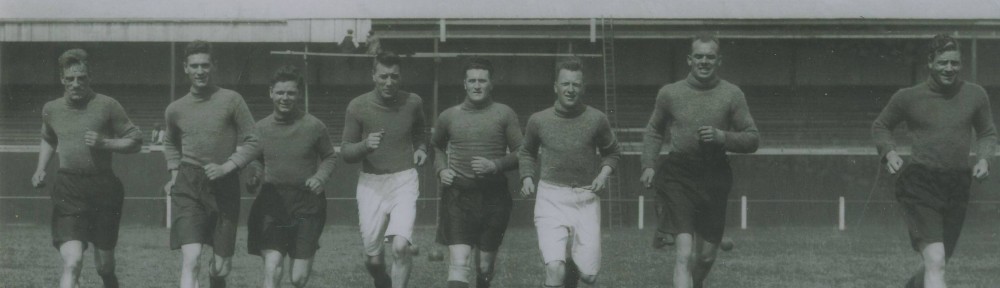
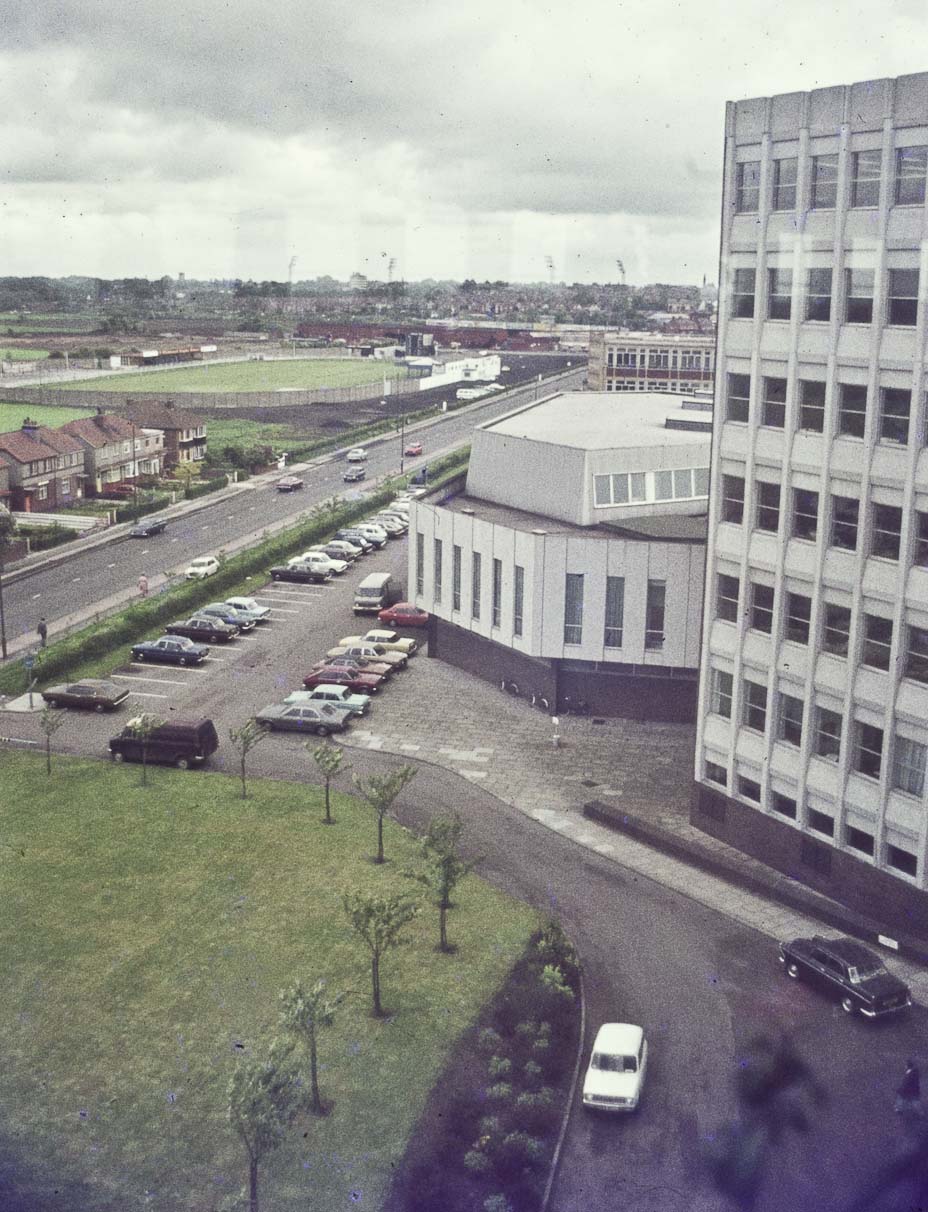
I came across a couple of fascinating photographs of the old Sealand Road ground recently and would like to thank former Manweb employee, Peter Thomas, for allowing me to use them. Peter’s pictures were taken from the top of the old Manweb building which was itself demolished at the turn of the century. I’ve added a couple of my own pictures, taken in 1990, which also show the outside of the ground from a slightly different viewpoint.

The two Manweb pictures show the view looking up Sealand Road towards the city centre. The patch of green on the left of Sealand Road is the Greyhound Stadium with the old football ground just above it. I think that the pictures were taken in the mid 1970s based on the work that appears to be taking place between the two stadiums. I believe that this is the construction of the small industrial estate that was built following the sale of the old training annexe in 1973. It also appears as if the picture was taken before the new office block was built at the front of the ground, around the time of promotion in 1975. You can just make out the old wooden office at the corner of the Main Stand and Sealand Road End. The old wooden main stand was replaced in 1979.

The Greyhound Stadium was itself demolished around 1986 while the football ground was vacated in 1990 and then eventually knocked down in 1992.

The third picture was taken from the inner ring-road in spring 1990 and shows how much the old ground used to stand out on the skyline.

The final picture is taken from Bumpers Lane before the final game against Rotherham United in April 1990.

If anyone else has any further thoughts on the dates of the photos taken from the top of the Manweb building I would be interested to hear any comments.

Copyright © 2012 http://www.chesterfootballhistory.com All Rights Reserved
Observer Posters

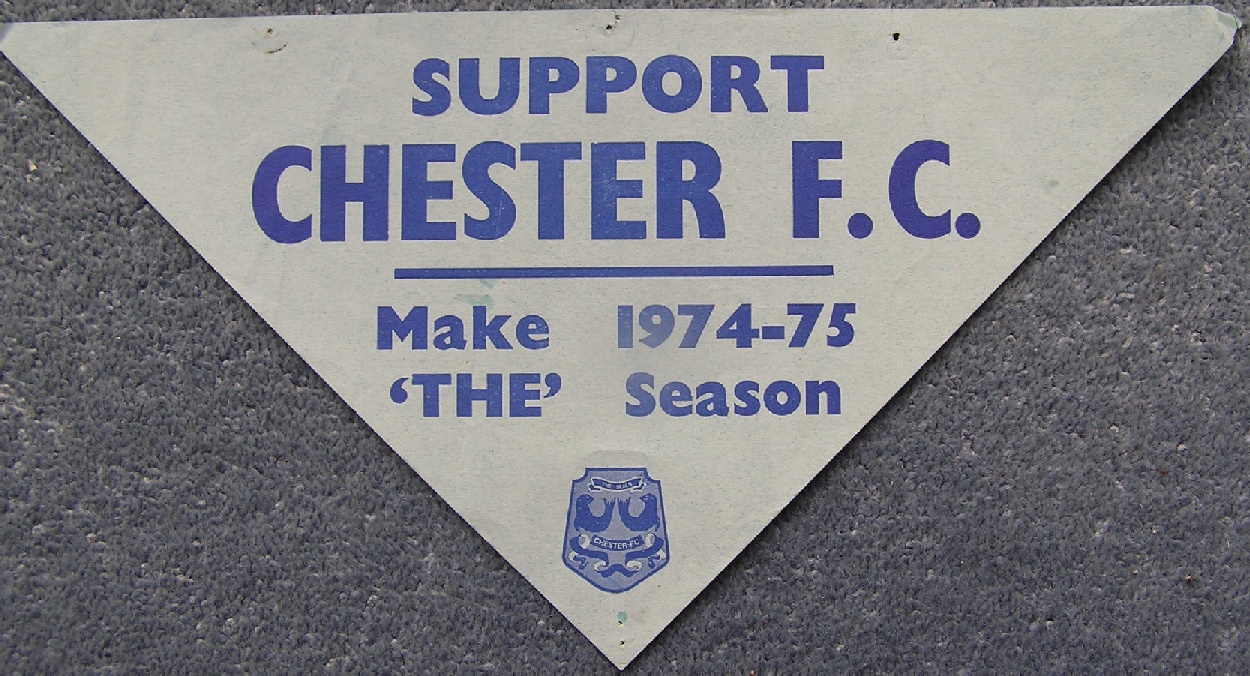
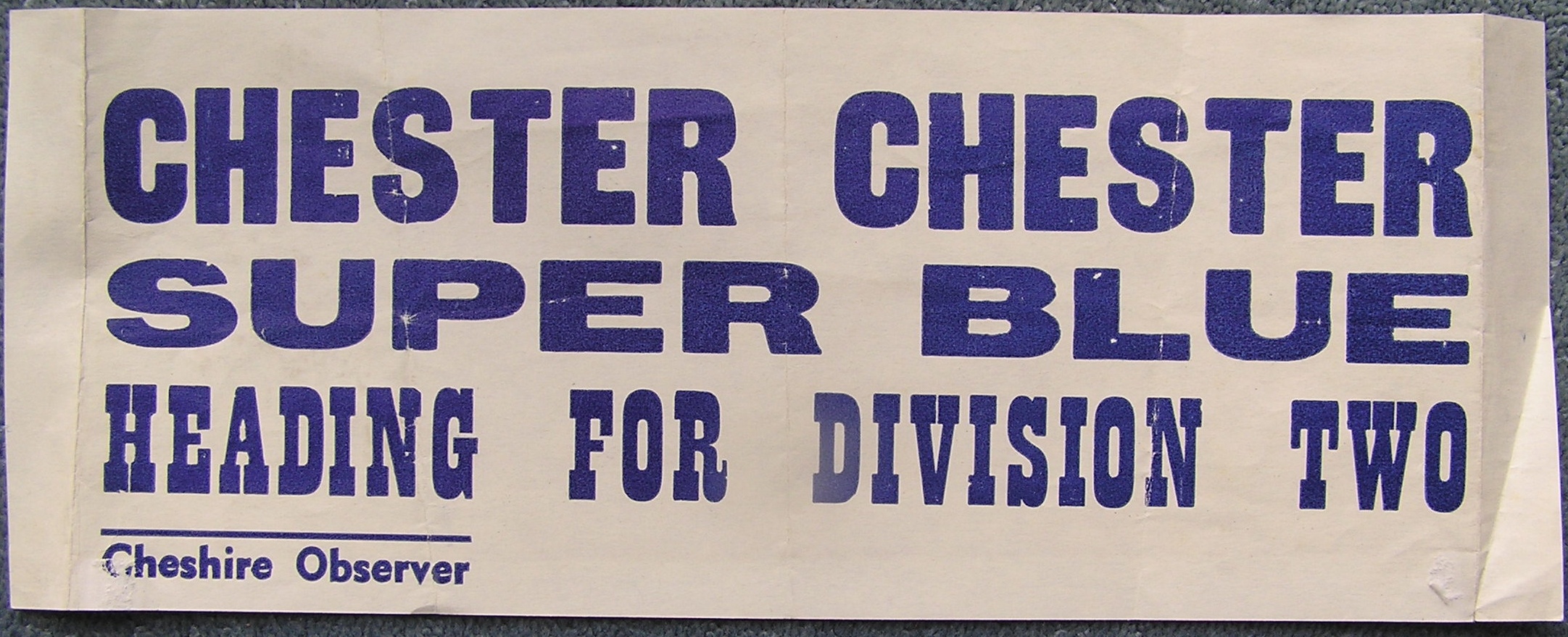
After I published the On The Buses article Tommy Jones reminded me about the car stickers produced by the now defunct Cheshire Observer in the mid-1970s. As a follow up I thought it might be an idea to put something together about these posters which even at the time seemed peculiarly dated.  I did write about them in a programme article earlier in the season but I’ve included a couple of additional examples for this piece.

I seem to remember that the very first one was launched during summer 1974 and have a vague memory of the Cheshire Observer asking readers what the phrase “Chester 3-4-5′ meant. At the time there was no indication that the phrase was linked to Chester FC so I don’t think anyone initially had any idea what on earth it was all about. For those still unsure it meant Chester for Division Three 1974/75. It may make vague sense now but it certainly seemed obscure when it was introduced. I haven’t got an example of the Chester 3-4-5 sticker but if anyone else has got one I’ll add it to the piece.

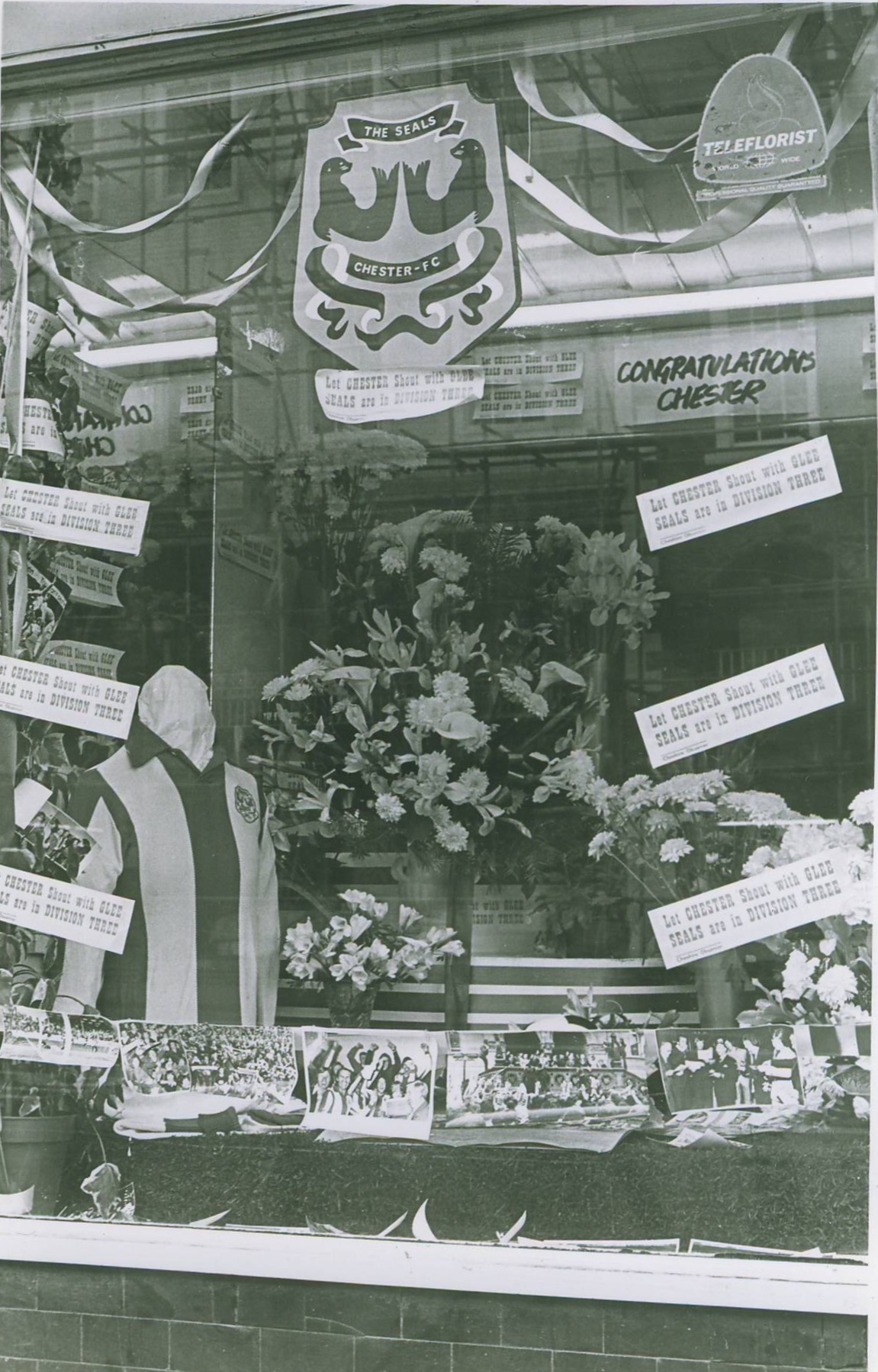
Chester 3-4-5 was quickly followed by Support Chester FC and then Forget The Cup We’re Going Up after the League Cup Semi-Final defeat to Aston Villa Following promotion the Observer went into overdrive and produced the classic “Let Chester Shout With Glee Seals Are In Division Three”. Possibly the last time the word glee was used in any sentence until the recent television programme salvaged the word from obscurity.

Flush with success the Observer then produced two more stickers for the first season in Division Three.

Chairman Reg Rowlands went to town with the stickers following promotion by proudly displaying a selection in the window of his florist’s shop in Bridge Street along with other memorabilia.

Reg Rowlands shop after promotion in 1975

I’d be interested to hear from anyone who knows if any other stickers were produced.

Copyright © 2012 http://www.chesterfootballhistory.com All Rights Reserved

On The Buses

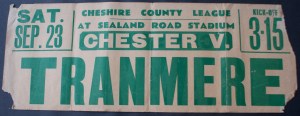
Older Chester supporters may remember the match adverts that used to appear on the maroon Corporation buses in the 1970s. I can remember the luminous green posters on the school buses and it was not unknown for them to end up in the hands of Chester supporting school kids. I managed to pick up a couple myself after they mysteriously worked themselves loose from the bus window. Larger versions of these garish adverts were also located on boards outside the Stadium. In the late 1970s it was possible to buy small card versions for 10p from the club shop which used to occupy the Georgian House on Grosvenor Road.

At a recent Senior Blues meeting I was talking to supporter Fraser Warburton who was telling me that these adverts appeared on buses as long ago as the early 1960s which surprised as I always thought they were a 1970s phenomenon.

The examples here are from the 1961/62 season when Chester played in green and gold and this is reflected in the colour of the posters although it looks the background may have faded slightly.

Fraser remembers cycling down to Stamford Road in Blacon where the buses used to wait before returning to the city centre, and asking the conductor if he could have the posters.

Games continued to be advertised until summer 1967 when the club objected to the council’s decision to charge £50 to continue with the arrangement.

The adverts re-appeared in the 1970s and my first example is from 1976 but I have a feeling they may have existed before this date. Does anyone know when and under what circumstances they came back? I’m wondering if it coincided with promotion in the 1974/75 season when the council were perhaps eager to cash in on the club’s success. The last dated poster is from 1978 but again they probably remained on buses for a short time after this as I have some of the cardboard adverts from the 1979/80 campaign.I’m not sure that these adverts would work in the present day with de-regulation and anonymity of current buses and I’m sure health and safety would have a say about sticking posters on windows. Nevertheless they were an extremely useful marketing tool for the era when there were far fewer media outlets.

Copyright © 2012 http://www.chesterfootballhistory.com All Rights Reserved
500 Games – Full Breakdown

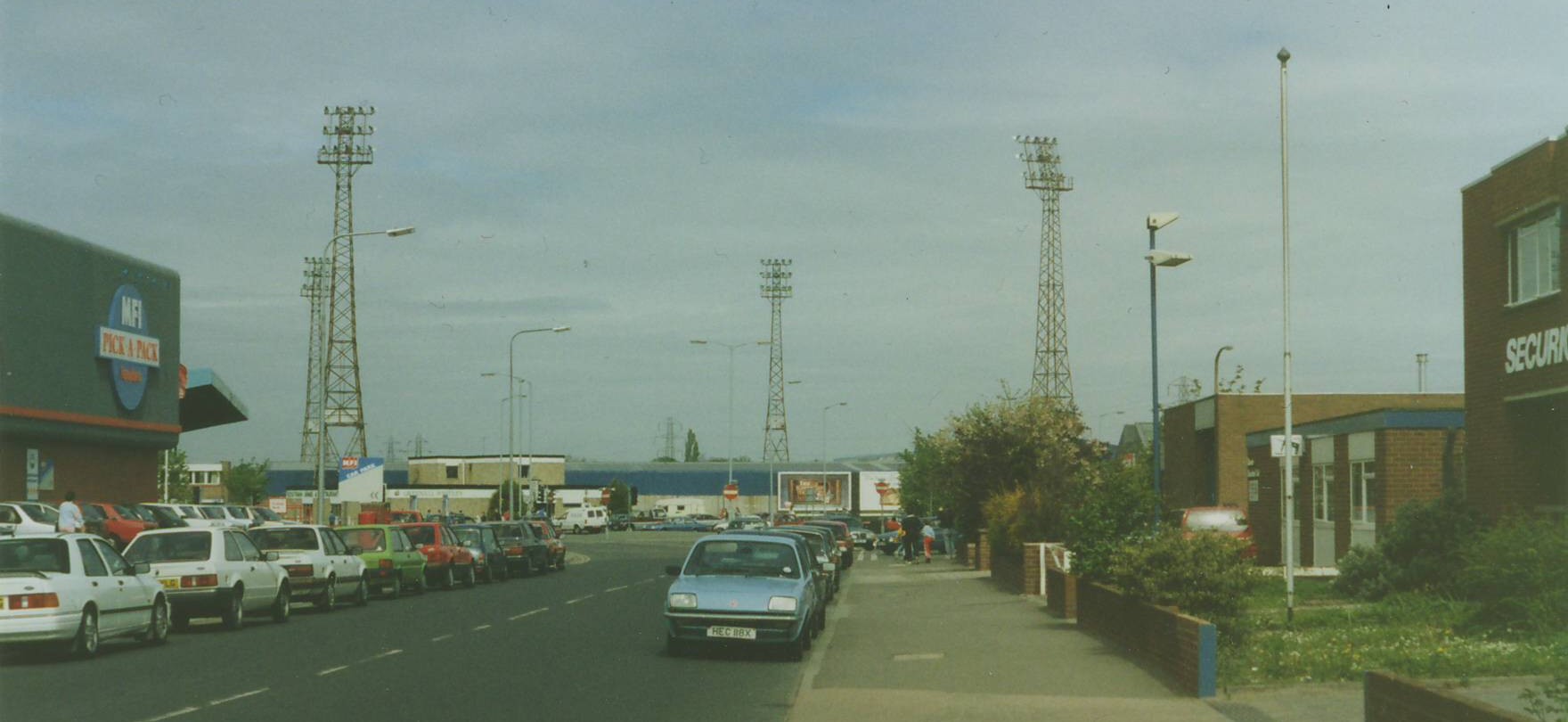
As promised, for those of you who like poring over dull statistics, here is the complete record at the Deva Stadium following the 2-1 victory against Mickleover Sports on Saturday. The row and column headers should be self-evident.

It is noticeable how poor the home record is for the old City side with almost as many games ending in defeat (165) as in victory (168). Perhaps this is unsurprising when you consider that four of the 18 seasons ended in relegation and the figures also include the disastrous 2009/10 season. In comparison there were two promotion seasons and two seasons where City reached the play-offs.

Inevitably the highest number of victories for City were chalked up in the promotion seasons of 1993/94 and 2003/04 as well as the 2000/01 season when they won seven games in cup competitions reaching the Third Round of the FA Cup, FA Trophy Semi-Final and Nationwide Variety Trophy Final. Perhaps more surprising is the fact that most goals were scored in the 1995/96 season when Kevin Ratcliffe was manager although there was the bonus of having Cyrille Regis leading the attack for two-thirds of the campaign.

The statistics for Chester FC put the previous 18 seasons to shame. The club have already scored 109 goals in total and suffered only four defeats compared to 29 victories.

There are a couple of anniversaries that should be reached before the end of the season. Chester FC need 6 more goals to reach 100 league goals while three more wins will see the 200th victory at the ground. In addition another 5 goals will see the 600th goal conceded but with a bit of luck this will be avoided until next season.

Copyright © 2012 http://www.chesterfootballhistory.com All Rights Reserved